Translate

Showing posts with label Long Term Interior Student Work. Show all posts

Saturday, September 1, 2018

Annie Thompson, Student Work


“Somewhat Alive”

My intention is to create an experience that appears subtle while conveying a sense of power.
The draped fabric appears quite and subtle. The shades of pink create a monochromatic atmosphere
of fleshy life. The sheets are connected to an inner motor so that every few moments both forms
pulsate at their own rhythm. Sporadic thuds can be heard as the mechanism turns.This installation
creates a delicately engaging interaction with the viewer, as its calls attention to itself if the
viewer is willing to stop and experience the limited movement.

Materials:
Cotton fabric
Rotisserie chicken motors
Wood
Wire

Installed in Molly Wiley Art Building, Flagler College, St. Augustine, Florida
4' x 7' x 3'


 View from first floor of art building.


Wednesday, May 3, 2017

Joseph Provenza, Student Work


Mom
Fabric, paint, lazer prints, frame, artificial light.
3.5' x 7' x 3'


Kimmy Schander, Student Work


"Reflecting on Man Draining Nature: Diffract, Refract, Reflection" 

48" X 48" X 108"

Found tree trunk with PVC pipe embedded, more PVC pipes, tree branches, wrapping paper, assorted glass jars, water, glycerin, glass rods, and red acrylic paint

Statement:
After I gathered all my materials, I sat in the space with my tree trunk and pipes, allowing the three walls to surround me. I wanted it to shape my emotions, somehow, and incorporate my thoughts on nature. I was still reflecting on how light bends objects through water, too....and then the pipes spoke out! I immediately thought about how we are draining nature, and began incorporating all my previous ideas, and this one, into a whole new one. My goal being,  that my viewers would grasp a similar experience because our Earth's natural resources are diminishing,  and man is to blame. Winifred Gallagher called it "The Science of experience" in "The Power of Place. Yes, we need to reflect on how man is draining nature. We need to diffract from our current ways refracting in the light of nature. . .bending with the waters of willpower, and change our wasteful ways, before we drain her dry. 


Saturday, February 4, 2017

Hope Delemeester, Student Work, Installation


Statement:
The theme for this piece is "what was left behind". Chuck Palahniuk's book Doomed served as inspiration. I set out to create my version of Hell in the form of a prison cell. My hell consists of black walls, a perfectly egg shell white desk, a never ending supply of king size candy bars and a telemarketing phone I'm forced to use. On top the desk I placed a brochure in the form of a welcome packet to the "Last Job of You'll Ever Have", a "Map of Hell" and a list of "Specific Useless Questions" to interrupt happy families sitting down to eat. 

Black, plastic garbage bags lined the walls, ceiling and floor. I designed "prison bars" out of wood dowels that I painted silver and hung from the wall with hooks. I also built the desk and designed the brochure and map on the computer.  The viewer was not able to enter the space. Rather, the viewer had to peer through the bars to examine the contents. 


Setting up lights (from upstairs photo studio) to take professional images. 


Ellie Wools, Student Work, Installation


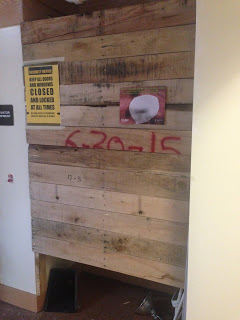
This piece was meant to evoke a certain level of anxiety. I boarded up a small alcove in the art building, leaving only a glimpse of what was behind the boards. I included sound in the form of a florescent bulb buzzing to enhance the anxiety. 


Sunday, April 24, 2016

Nicki Smith, Student Work


Artist Statement:

This piece was inspired by the concept of mental illnesses and how only the person going through it is the one who truly understands it. Even then, they may not understand what they're going through entirely. A major inspiration for this piece was the book and movie One Flew Over the Cuckoo's Nest. The fog that the main character deals with and the ambiguous clarity that it lacks intentionally to make you think and try to understand. This piece can resonate with everyone differently. When I began the installation, it was to capture the emotions of a schizophrenic person. After a bit, I began to connect with the work in a different way  - as if the eyes were people and watching me.  There's a clear distress and uneasy situation going on, but the actual explanation of what is going on is left up to the viewer.


Details


Foam Board Models


Monica Stauffer, Student Work


Synesthesia | Natural History of the Senses

Artist Statement
Synesthesia is the the production of a sense impression relating to one sense or part of the body by stimulation of another sense or part of the body. The most basic example is seeing letters or numbers in a certain color, or identifying certain sounds with colors as well (low sounds are dark colors, high sounds are light colors). It’s a union of the senses, a sensory overload, a luminous spill of sensation. It’s caused by the limbic system not being governed by the cortex. 
Many creatives have this; it allows them to have the ability to create a piece of art that conveys an emotion. It also can act as a sort of mnemonic device, to help aid in remembering an idea, or sparking a thought (sex, tea, cigars, and baths are all historical examples). 
Experiencing synesthesia is a very personal thing, and differs from person to person. However, there are daily occurrences of synesthesia in almost every person. 
When you walk into a building, you usually experience a change in your mental or emotional state. Entering a church gives this sense of holiness, of grandeur, because of it’s size as well as ornamentation. However, this is a completely different experience than you feel when you walk into a house, particularly your home. Your home is your safe haven, where you feel most like yourself, where you return to to remember who you are. It’s comfortable, and most likely does not leave you with the feeling of divinity. 
Physical spaces have an emotional impact on us. The way a space is designed and laid out causes this impression. And that is what I set out to do with this installation: create a physical space that, upon entrance, causes you to feel calm and collected, contained, yet still a part of the world. 
The other goal was to draw attention to an architectural feature. The site that the installation was set up in has a wooden beam coming down from the highest point to the corner in this alcove. It seemed the perfect thing to draw attention to, to mimic. 
The purpose of the thread is to lead the eye of the viewer to this corner: the eye moves in, and then up. It pulls you in, as numerous lines lead to this point. That is how the viewer ends up being in the space. Once in the space, the numerous angles of the thread create a sort of wall, making the viewer feel enclosed, yet not to the point of being separate from the world. It’s calming, a space to be in when you don’t wan to escape completely. 
The physical appearance and experience of the space cause an emotional and mental connection with the viewer, achieving synesthesia. 

Tuesday, January 26, 2016

Kevin Mahoney, Student Work


Natural History of the Senses
For this project I set up a microphone going through a loop pedal going through an amplifier. All of this was covered with a red velvet curtain to add a layer of mystery. So as the business of the Molly Wiley Art Building happened each day, the sounds of it’s inhabitants would be reflected back into the building. Each time the sounds would loop they would loop back on top of eachother, building up into a sea of feedback. I placed a mirror behind the curtain so that nosy viewers would be able to see that it was, in fact, them making the music. Unfortunately I faced problems with people not wanting to listen to the music and I also faced problems with the microphone on my camera not picking up the sound as it truly happened. I feel that this piece would be specific to whatever site it was installed in and I feel that it operates more as a physical experience that does not lend itself very well to documentation.

Research:
John Cage
Research/Inspiration:

Michelle Behling, Student Work


The sense I chose was hearing:

"Sea robins, drum-fishes and many others make sounds with their swim bladders; croakers grunt loud enough to keep China Sea fishermen awake at night; Hawiian triggerfish grind their teeth loudly ; the male toadfish growls; bottlenose dolphins click and squeak like badly oiled office chairs..." (198)
Diane Ackerman, Natural History of the Senses, 1990.

This part of the chapter made me think a lot about the natural sounds in our environments. When I go to sleep at night, the sounds I hear are the refrigerator and other electrical humming sounds. I wanted to respond to the abundance of mechanical sounds that can be heard throughout the day. Often I think we tune out these sounds and then blend into the background. However, in most building these sounds are present. I think it's interesting that often lights and machines buzz more and more with time as the parts wear down, making them impossible to fabricate.

I wanted to interfere with the space and create mechanical noise in the background to alter the sense of hearing.  I tested several types of lights using an electronic dimmer, a common cause of humming lights, to test the volume and sound of the hum. Although this experience has visual sensory information, it is primarily meant to be felt as an auditory experience.  I attempted to partially shield the visual aspect of the light with a curtain in my installation.

Ultimately this project was my first experience with lighting and sound. At first, I was unsure if I could even produce humming lights, as they are considered a problem meant to be solved. It seemed as if this project was the backwards solution to a problem- a solution created through a reverse process. 

Research:
http://homeguides.sfgate.com/fix-humming-incandescent-light-fixture-34036.html
https://www.smarthome.com/sh-solutions-why-do-lights-buzz-when-using-dimmer.html


Andrew Hollingsworth, Student Work

Installation in response to an excerpt titled the Painter's Eye 
from Diane Ackerman's A Natural History of the Senses.


Emily Lowell, Student Work


Touch Chapter
From the book A Natural History of the Senses by Diane Ackerman

Maja Hydbom, Student Work


Chapter - Smell, A Natural History of The Senses by Diane Ackerman
Metal, tights, ceramic, petals, lace and a red light

I created this site-specific installation after reading the chapter on Smell in A Natural History of The Senses, by Diane Ackerman. The chapter was interesting mostly for the informational part, such as; learning that children likes all smell until they are taught differently, smell is the most direct of all senses, women are not drawn to men’s natural scent, humans like smelling flowers because they have an energetic sex life and that is a plausible reason why we spray ourselves with fragranced perfume- to feel desirable. I wanted to create an installation that would endorse the idea of scent, but not actually smell of anything. I created a crucifixion of the female sexuality as it is commonly portrayed as something sinful, although it being natural. The crucifixion has been turned in to a drainage, hence the pipe like support, that stands to capture the infamous sexuality.
My research for this project includes the works of Robert Gober. See below. 


Alex McNutt, Student Work


Sense: Touch
from the book A Natural History of The Senses by Diane Ackerman
I chose to create my hallway installation based on the sense of touch. Yarn World was built February 17, 2014. I wanted to create an enclosed space where you could not avoid being touched. In the book "A Natural History of the Senses" Diane Ackerman talks about hair being a receptor of touch. When something is close to our bodies our hairs get all tingly and sends information to our brain that something is there. Yarn World was supposed to be a kind of claustrophobic touch overload. When you step inside Yarn World you are being touched by thousands of strands of yarn coming from all sides.

The part of the book that I took the most inspiration from was the section titled "Adventures in the Touch Dome." Mostly I just think that is a great title. I imagine a giant dome packed full of different objects to touch, all the different textures and consistencies. That is essentially what you do at San Francisco's Touch Dome apparently.

http://www.exploratorium.edu/visit/west-gallery/tactile-dome

In the Tactile Dome you explore the pitch darkness using only your sense of touch. Yarn World is a similar concept. I created Yarn World by covering the brown floor and skirting the walls with white paper which I taped to the top of each wall. I then created a false ceiling out of foam board to hide the pipes above as well as to give a surface to attach yarn to. Using multi-colored duct tape I taped strips of yarn which I cut to reach just above the floor to the foam board ceiling above. I used 12 rolls of yarn and calculated that there are over 1000 strings of yarn hanging. I then hung a thick yellow curtain in front of the yarn with an opening so that you have to enter into the curtain to find the yarn. Over the top of the curtain I created a sign on foam board to seal the top of the curtain and invite guests in.

I wanted Yarn World to be playful and have almost an amusement park feeling but also be a little intimidating and make the guests feel uneasy about being inside the tiny space.

Marlena Lomonaco, Student Work

Response to Touch, a chapter from the book A Natural History of the Senses by Diane Ackerman

Installation, includes video.

Link here to watch video and see images of installation.

http://marlinstalls.tumblr.com


Josh Slinski, Student Work


Monday, June 17, 2013

Kasha Fahy, Student Work


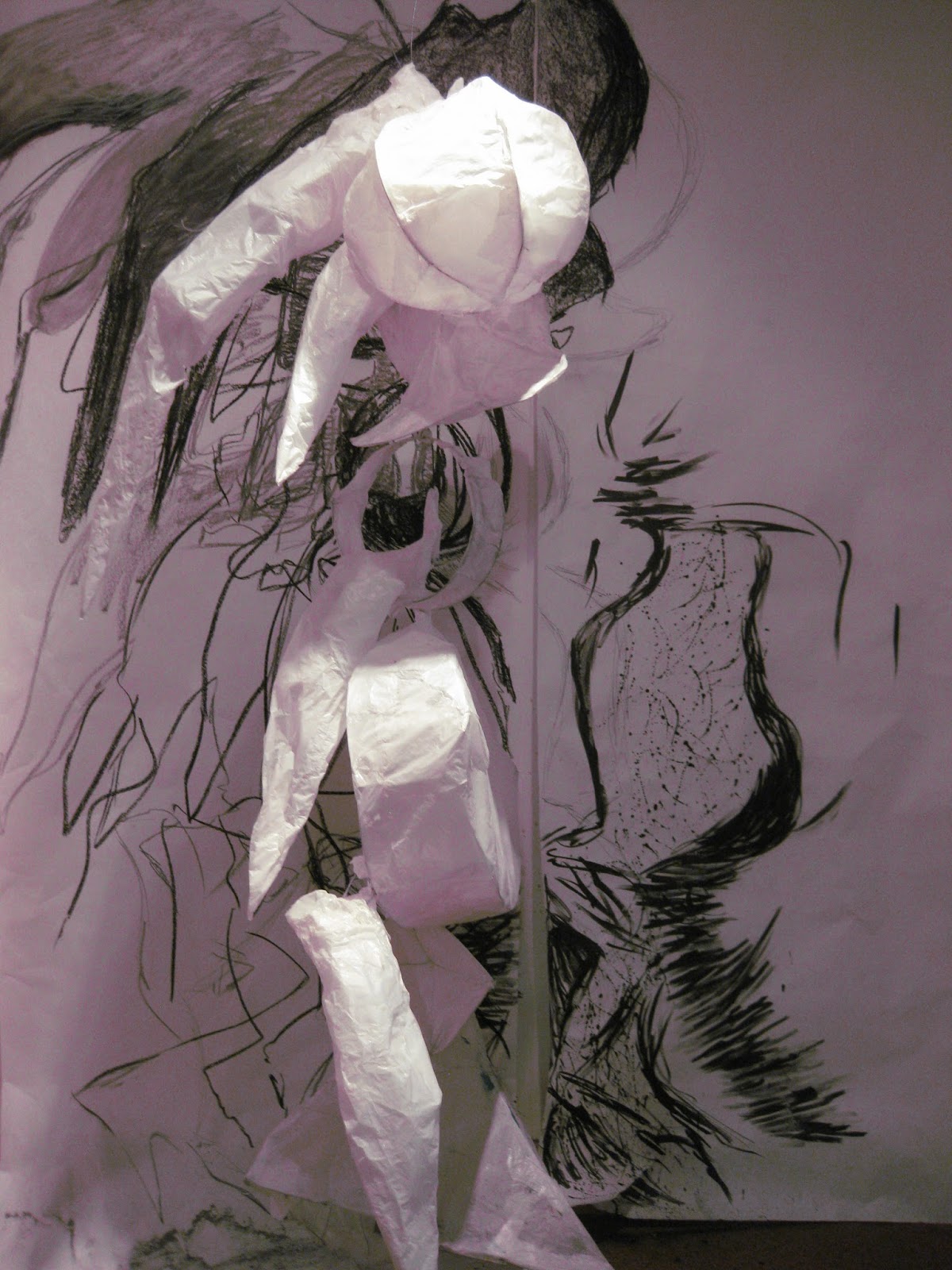
Sculpture measures approx. 7' tall and 3' wide.
Materials: wire, tracing paper, gel medium.
Drawing consists of two panels, each measuring 8' x 3'.
Materials: charcoal, ink, pencil, pastel.