Translate

Showing posts with label Video. Show all posts

Monday, February 13, 2017

Emily Ward Bivens, Artist


Embed - object, live feed video, projection.


Semblance I - object and live video feed.


Foot - objects and video projection. 


Friday, January 6, 2017

Antony Gormley, b. 1950, London, United Kingdom


Another Place


The Angel of the North
Antony Gormley
Gateshead, 1998
Since it was unveiled on Valentine's Day in 1998, an estimated 90,000 people a day have seen Gormley's Angel of the North, making it Britain's most famous piece of public art. Standing on the site of an old colliery in Gateshead, the towering steel sculpture pays tribute to the industrial heritage of the North East. 


Sol LeWitt, b. 1928 , d. 2007, American


Inverted Spiraling Tower,  1987


The Location of Lines
Lines From The Ends of Lines 98


The Location of Lines
The Location of Straight Line not Straight Line and Broken Line 98


Working Drawing for Wall Drawing 937
1999


Blue Wall

Starting from the simple but radical new idea that an artwork's concept is more important than its form, Sol LeWitt helped revolutionize the definition of art in the 1960s. By the middle of that decade, LeWitt had rejected the dominant, psychologically charged abstract style of artmaking for impersonal, geometric forms. By repeating and varying a single principle, he created sculptural structures that were aesthetically satisfying even as their internal logic was pushed to the edge of irrationality.
LeWitt's procedure of repetition and variance is also the basis for his wall drawings. Each of these impermanent artworks consists of a set of the artist's instructions, something like a musical score, with the actual execution carried out by someone else.
Over the years, LeWitt's austere compositions gradually became more complex and sensuous, though they remained true to his original precepts.


Tuesday, January 3, 2017

Rocking Chair That Knits


Damien Ludi and Colin Peillex, students at the University of Art and Design Lausanne, have come up with a rocking chair that knits as you sway back and forth. 
Called the Rocking Knit, the wooden chair has gears above your head that utilises kinetic energy to knit. Each swaying motion powers the gears, which sends yarn to a knitting round. The final product is a cosy red beanie made with minimal effort (so long, needles!).
The contraption was made as part of a program that encourages students to make a machine that creates both an experience and a material good.

Saturday, May 21, 2016

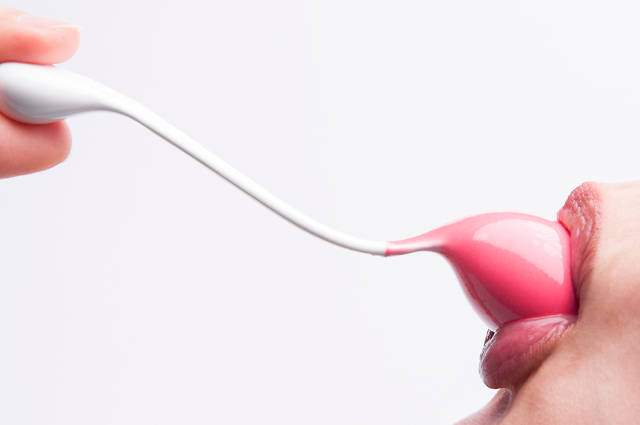
J I N hyun Jeon, Sensory Cutlery Collection, 2012


Watch Sensory Dining Experience, Click here Vimeo

Cutlery design focuses on getting food in bite-sized morsels from the plate to the mouth, but it could do so much more. The project aims to reveal just how much more, stretching the limits of what tableware can do. Focusing on ways of making eating a much richer experience, a series of dozens of different designs has been created, inspired by the phenomenon of synesthesia. This is a neurological condition where stimulus to one sense can affect one or more of the other senses. 
An everyday event, ‘taste’ is created as a combination of more than five senses. Tasty formulas with the 5 elements – temperature, color, texture, volume/weight, and form – are applied to design proposal. Via exploring ‘synesthesia’ if we can stretch the borders of what tableware can do, the eating experience can be enriched in multi-cross-wiring ways. The tableware we use for eating should not just be a tool for placing food in our mouth, but it should become extensions of our body, challenging our senses even in the moment when the food is still on its way to being consumed. Each of designs have been created to stimulate or train different senses – allowing more than just our taste buds to be engaged in the act and enjoyment of eating as sensorial stimuli, therefore it would lead the way of mindful eating which guides to rediscovering a healthy and joyful relationship with food. 
 The materials in the design currently compose of metal, plastic and ceramics. Each material possesses its natural temperature, which works in harmony with the intent of the design.  From the thickness of the handle to the volume mass of the spoon, it evokes a different effect. Weight distribution changes according to the thickness and the volume affects the sound vibration. Each of these features is subtle but in combination, they harmonize into enhanced tasty effects. As for the specific workings of the features of the design, it could be understood through the elaboration of the five elements – temperature, color, texture, volume/weight and form.
Enhanced Tasty Formulas
 
Temperature
SWEET × 36.5°C = SWEET × +++
SALTY × < 36.5°C < SALTY × < 0°C
SOUR × 36.5°C = SOUR × 100°C
BITTER × 36.5°C > BITTER × 100°C
 
Tactility
+++ ×  (SWEET + SALT) = X
SWEET + (0.5% × SALT) = SWEET ++
SALT ÷ SOUR = SALTY/SOUR -
SALTY × SOUR = SWEET +
 
Colour
10% × (5R 4/14 + 5YR 4/14 + 5Y 4/14) = 2.0
90% × (5R 4/14 + 5YR 4/14 + 5Y 4/14) = 0.1
20% × R > 20% × Y
 
Volume/ Weight
5cm3 × SOUND/ SIGHT = 10g × TOUCH
 
Form
1mm × TOUCH > 10mm × TOUCH
(y=f(x)) × TOUCH = Y


Designer Jinhyun Jeon was born in South Korea, based in Eindhoven, the Netherlands. Jeon received BA in Product Design and completed MA in Spatial Design at Hongik University, Seoul, Korea in 2008. She moved to the Netherlands, gained MD in Social Design from Design Academy Eindhoven in 2012 and established Studio Jinhyun Jeon.
 
jihyun.com
 

Sunday, May 1, 2016

Omer Polak, Industrial Designer


Designer Omer Polak's 'Blow dough' project manufactures dough balloons using an industrial blower
EMMA HUTCHINGS 
Israeli designer Omer Polak is a graduate of the Department of Industrial Design at Bezalel Academy of Arts and Design in Jerusalem. Polak inflated food as part of his “Blow dough” art installation, which illustrates the food manufacturing process in a small-scale factory that was established for one day as an analogy to street food carts and the urban eating experience in Jerusalem.
The inflated food designs were created with flour and water, inspired by popular Jerusalem food scene ingredients found in pita bread, bagels, bans, and more. The aim was to exhibit to viewers an open and transparent scene of the production process as well as a fresh perspective on dough.
“Blow dough” manufactured dough balloons using an industrial heat blower, with temperatures reaching as high as 600-degrees Celsius. This made the seasoned dough bake while blowing it into the shape of an inflated balloon. In the manufacturing process, local herbs were added to the blowing and assimilated into the dough, which helped to enrich the entire eating experience for those involved.
This project was created for the Jerusalem Design Week, and it reflects many aspects of Jerusalem. The multicultural city hosts many types of foods, dishes and eating habits influenced by different cultures. The local food in Jerusalem is usually referred to as “street food” and characterized by a similar food-making process, which surrounds one small counter where all the magic happens.
One of the most popular and common ingredients in the Jerusalemite food arena (and the entire middle east) is the various different types of bread. This is why the very basic ingredients of flour and water were chosen for this project and combined with the designer’s creative processes.
The “Blow dough” food design project offers a new perspective on dough uses by borrowing the producing process from other industries. It also enables the participants to view and be exposed to the food process both openly and transparently. You can check out the design process and see lots of people creating dough balloons of various shapes and sizes in the video below:
source link here

Sunday, April 24, 2016

Rachel Whiteread, Artist, b. 1963, United Kingdom

Holocaust Memorial, Vienna


Book pages face outward - viewer cannot read title of books.
65,000 Austrian Jews, 1938 - 1945. 
Alphabetical order, name of camps around base. 
Doors have no doorknobs or hinges. 
Resembles a bunker.
The sculpture is a cast of negative space. 
Space between us and the books. 
Concrete chosen for familiar/common material. 


"Given this thematic edge in all her work, it is not surprising that Whiteread was one of nine artists and architects invited to submit proposals for the Vienna Holocaust memorial. Other invitees included the Russian installation artist Ilya Kabakov, Israeli architect Zvi Hecker, and American architect Peter Eisenman. As proposed, Whiteread’s cast of a library turned inside-out measures ten by seven meters, is almost four meters high, and resembles a solid white cube. Its outer surface would consist entirely of the roughly textured negative space next to the edges of book leaves. On the front wall facing onto the square would be a double-wing door, also cast inside out and inaccessible. In its formalization of absence, on the one hand, and of books, on the other, it found an enthusiastic reception among a jury looking for a design that “would combine dignity with reserve and spark an aesthetic dialogue with the past in a place that is replete with history.”16 Despite the jury’s unanimous decision to award Whiteread’s design first place and to begin its realization immediately, the aesthetic dialogue it very successfully sparked in this place so “replete with history” eventually paralyzed the entire memorial process.


Prisoners files in small fort office, Theresienstadt. Photo, Dirk Reinartz


Four minute video that shows Whiteread planning and working on the memorial.

https://vimeo.com/47024557


I found this personal video made by a visitor to the memorial. 


Whitehead talks about her work, 2011. 

Monday, September 7, 2015

Zimoun, Artist


36 ventilators, 4.7m³ packing chips

Zimoun 2014

Motors, metal, styrofoam, nylon, wood, controlling system. Dimensions: variable.
Installation view: Art Museum Lugano, Switzerland.

Curated by Guido Comis and Cristina Sonderegger. Studio and/or on-site production assisted by Matteo Taramelli, Ulf Kallscheidt, Janis Weidner, Elisa Tangheroni, Benoît Villemont, Riccardo Stephani, Alessandro Lucchini, Nicola Del Signore and Valentina Brkovic. Controlling system developed in collaboration with Jason Cook, Alexandre Saunier and Grégoire Lauvin, at the Digitalarti Laboratory in Paris. Photographies and video by Zimoun.  


236 prepared dc-motors, wire isolated, cardboard boxes 41x41x41cm

Zimoun 2011

DC-motors, wire isolated, cardboard boxes, power supply. Dimensions: height 3.5m, Ø 4.8m / height 11.5 ft, Ø 15,7 ft. Installation view: Ringling Museum of Art, Sarasota, Florida, USA. Curated by Matthew McLendon. Exhibition design by Matthew Harmon. Project coordination and assisted by Stephanie Sherriff. Assisted by Vanessa Gageos, Florian Bürki, Matthew Harmon, Kyle Petreycik, Alvy Vereecke, Emily Martin, Morgan Janssen, Chris Schumaker, Gabbi Ricci, Tracy Keenan, Diana Lueken, Lester Gessley, Alicia Stein, Emily Meyer, Chris Degrer, Alex Wyllie, Katelyn Bobek and Anna Paul. Exhibition coordination by Donn Roll. Conservation by David Piurek. Volunteer coordination and academic affairs by David Berry. Photographies and videos by Zimoun. Kindly supported by Pro Helvetia - Swiss Arts Council.

Video: https://vimeo.com/32012831


Watch on website. Link here

43 prepared dc-motors, 31.5kg packing paper

Zimoun 2013

DC-motors, paper, nylon, wood, power supply. Dimensions: Size variable.
Installation view: Orbital Garden Bern, Switzerland.

Curated by Don Li and Jahn Antener. Studio production assisted by Elisa Tangheroni, Valentina Brkovic, Matteo Taramelli, Janis Weidner, Ulf Kallscheidt and Till Hillbrecht. On-site production assisted by Elisa Tangheroni, Valentina Brkovic, Matteo Taramelli, Paul Hügli, Don Li, Jahn Antener, Li Rotzler, Marc Beekhuis, Hannes Zweifel, Micha Bürgi, Simon Petermann, Jelena Savic, Monika Grossen, Jahn Mazel and Nina Wagner. Video by Studio Zimoun. Supported by KulturStadtBern, Swisslos / Amt für Kultur Kanton Bern, Migros Aare and Burgergemeinde Bern.


More to see on artist's website. Link here

Wednesday, May 2, 2012

Balint Bolygo, Artist


"Trace is a sculptural device that alludes to scientific discoveries and pseudoscientific concepts such as phrenology, physiognomy, and craniometry. A revolving plaster cast of the artist's head is slowly deconstructed into a mathematical diagram that changes as time passes. The peculiarities of the human face that as humans, we attach so much importance to, is dematerialised into a changing drawing that embodies the differential undulations of the human anatomy. Trace questions our notion of self and how through technology we have found different visual representations for the individual. DNA profiling, retina scans and the fingerprint are all things that are conjured up by the meticulous mechanical process of the work. The topographical images are turned into a new form of three-dimensional representation that draws our attention to the space within." - source is artist's website.  Link here to see more work.