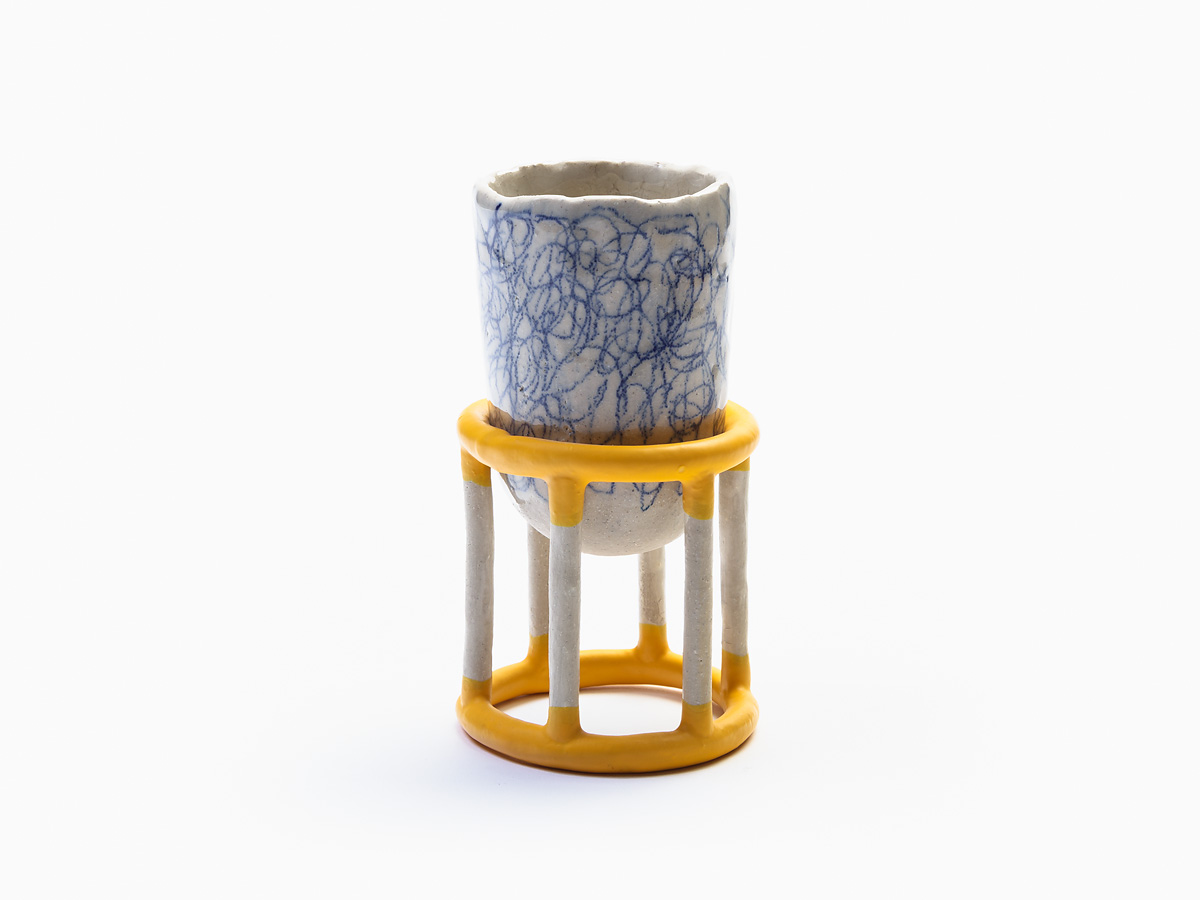
Above image an example of "stacking".
These examples can also inspire the prompt "mountain"
for the 22 Sculptures Assignment
2007
Ruth Duckworth, a sculptor whose work in clay and bronze included monumental sculptures and murals, as well as small-scale, intimate pieces, died last Sunday in Chicago. She was 90.
Her death was confirmed by Thea Burger, her agent.
Ms. Duckworth followed an idiosyncratic career path, starting as a stone mason in Britain and not turning to ceramics until her 40s, bringing a sculptor’s sensibility to it. Intent on doing large-scale ceramic work, then out of favor in Britain, she accepted a teaching appointment at the University of Chicago in 1964 and began executing monumental ceramic murals and, later, bronze sculptures.
Her stoneware murals, notably “Earth, Water and Sky” (1967-68) and “Clouds Over Lake Michigan” (1976), incorporated topographical swirls and abstractly rendered cloud patterns. Her small works, by contrast, were often delicate and abstract, with surrealist overtones. The influences were varied. The stylized modernism of Henry Moore, Constantin Brancusi and Isamu Noguchi competed for attention with Egyptian, Mexican and Cycladic art.
“She was a great original, pioneering her own path within ceramics, brilliantly exploring the idea of the figure, the vessel and the more abstract form,” said Emmanuel Cooper, a British ceramist and an editor of Ceramic Review.
Ruth Windmüller was born in Hamburg, Germany, on April 10, 1919. Because her father was Jewish, she could not receive an art education under the Nazi regime, so in 1936 she left Germany for Britain, where she studied at the Liverpool School of Art.
With the outbreak of the war she began traveling with her own puppet show in northern England and then found work in a munitions factory making bullets. After studying stone carving at the City and Guilds of London Art School, she worked for a time carving tombstone decorations.
In 1949 she married the sculptor Aidron Duckworth. The marriage ended in divorce. She is survived by a sister, Ilse Windmüller of Holyhead, Wales.
After visiting en exhibition of art from India, Ms. Duckworth resolved to become a ceramist and enrolled at the Central School of Arts and Crafts in London in 1956, mainly to learn about glazes. Initially she produced tableware in stoneware and porcelain, but gradually her work became more abstract and sculptural, with forms suggesting pebbles and rocks. It also assumed grander dimensions.
Ceramists, most of them wedded to the tradition of functional pottery thrown on a wheel, puzzled over Ms. Duckworth’s hand-shaped works. Sculptors, working in wood, stone or metal, took a dim view of clay as a medium.
lthough it was dismissed out of hand by Bernard Leach, Britain’s leading ceramist, her work made an immediate impact on younger artists. “Ceramics studios across Britain were soon bursting with pinched porcelain fungi and swelling stoneware fruits,” Tony Franks, an English ceramist, recalled in the Australian magazine Ceramics in 2007. “Organic clay had arrived like a harvest festival, and would remain firmly in place well into the ’70s.”
After taking up a teaching post at the University of Chicago, where she remained until 1977, Ms. Duckworth was commissioned to execute a suite of murals for the entry atrium of the university’s new Geophysical Sciences Building. Using topographical illustrations of Mount Fuji and satellite photos of the earth, she created “Earth, Water and Sky,” a suite of murals covering four walls, with porcelain clouds suspended from the ceiling.
Her most important large-scale work, “Clouds Over Lake Michigan,” is in the Chicago Board Options Exchange Building. Mingling abstract and figurative elements, it depicts the watershed of Lake Michigan overlaid with archaeological fantasies and natural forms. A third major ceramic work was “The Creation” (1982-83), commissioned by the Congregation Beth Israel in Hammond, Ind.
In the last decade she completed several monumental bronze sculptures for the campuses of Eastern Illinois University in Charleston, Northeastern Illinois University in Chicago, and Lewis & Clark Community College in Godfrey, Ill.
Although she remained in Chicago after retiring from teaching, working since the 1980s in a former pickle factory on the city’s north side, Ms. Duckworth exhibited widely in the United States and Europe.
In 2005 she was the subject of a retrospective, “Ruth Duckworth: Modernist Sculptor,” which opened at the Museum of Arts and Design in Manhattan and traveled to six museums around the United States.
Correction: November 1, 2009
An obituary last Sunday about the sculptor Ruth Duckworth omitted part of the name of one of the colleges for which she completed monumental bronze sculptures in the last decade. It is Lewis & Clark Community College in Godfrey, Ill. — not Lewis and Clark College. (There is a Lewis & Clark College in Portland, Ore.)