Translate

Showing posts with label Ceramic Taste. Show all posts

Friday, October 21, 2016

Ideas for TASTE

Zhong zi is a delicious Chinese food that is basically sticky rice wrapped in bamboo leaf and steamed. We added chopped kabocha (squash), flaked roasted duck meat, and goji berries to some of the zhong zi to add some interesting flavors. To eat it, unwrap the leaves and use chopsticks to hold the sticky rice and dip it in white sugar or maple syrup. It's chewy, sticky, and has the refreshing taste of bamboo leaf!
Source artfulfood.blogspot.com


Black Beans. Source artfulfood.blogspot.com

Green Tea White Chocolate Ice Cream. Source artful foodblogspot.com


Artichokes

Mango pastry
Clay


Mont Blanc. Source artfulfood.blogspot.com

Clay


Apple cinnamon pull-apart bread. Source artfulfood.blogspot.com

Ceramic

Ceramic


Bon Bons

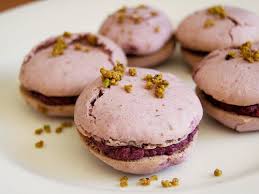
Macaroons


A baker prepares ensaïmades, a traditional sweet bread, at a bakery in Palma de Mallorca. The ensaïmada is a traditional Mallorcan dessert made with reduced pork lard. Source npr.org


Pomegranate Seeds


Pomegranate Seeds


Let Them Eat Sugar Sculpture! The Getty Celebrates Edible Table Art

One of the main attractions in "The Edible Monument" exhibition at the Getty Center in Los Angeles is a nine-foot long sugar palace showing the Greek sorceress Circe meeting Odysseus' men.
Abbie Fentress Swanson for NPR

November 20, 2015
Enter a Getty Center gallery in Los Angeles, and you'll be greeted by a nine-foot long sculpture of the Greek sorceress Circe transforming Odysseus's men into swine.
What's most remarkable about this piece is that every inch of it – from the ornamental balustrade to the fine pink, yellow and white sands in the miniature garden — is made of sugar.
The sugar palace might have been the centerpiece of an 18th century French wedding table. Today, it's part of a Getty exhibit called "The Edible Monument: The Art of Food for Festivals" that runs until Mar. 16.
"These very elaborate centerpieces in the middle of tables were made for people to admire while they ate and then the food would be served around them," says the exhibition's curator Marcia Reed.
At the end of the party, guests were often invited to break off pieces of sugar sculpture to eat or take home as souvenirs.
What "The Edible Monument" shows us is that our love of party decorations goes way, way back, says Reed. Besides this sugar art, the show features extravagant serving vessels and scenes, such as silver tureens with sculpted rabbits and heads of cauliflower, colorful scrolls depicting 16th century ox roasts and prints portraying triumphal arches made of bread, cheese and suckling pigs.
Sugar and pastry were two of the foods that moved out of the kitchen and into the artist studio during the Renaissance. The period's finest kitchens employed chefs and confectioners who knew how to handle sugar paste and turn it into sculpture. White sugar was prized by Europe's elite because it was pure, beautiful and exotic, having been imported from Africa and the Caribbean.
At the end of the party, guests were often invited to break off pieces of sugar sculpture to eat or take home as souvenirs.
Abbie Fentress Swanson for NPR
"Sugar is a great way of showing how skillful these past practitioners were because it is one of the few foodstuffs you can show in a museum without it decaying," says British culinary historian Ivan Day, who created the Circe sugar temple on display at the Getty with artist Tony Barton using sugar paste, molds and a 1749 French engraving. Day's latest sculpture should last a while; he says similar sculptures he made 30 years ago remain in good shape today.
It helps that when sugar is combined with gum and water, it becomes an extremely pliable paste that has the consistency of Play-Doh, according to Reed. She says the sugar paste used in the Renaissance period is comparable to wedding cake fondant we see today. When it hardens, this sugar paste has the color and substance of Necco Wafers.
Medieval sugar statues were the inspiration behind the sphinx artist Kara Walker installed in Brooklyn's Domino Sugar factory in 2014. "I was reading this book, Sweetness and Power [by anthropologist Sidney Mintz], and I came across these sugar sculptures called subtleties that they had at medieval banquets," Walker told the Guardian. "Up until that point, I had been thinking of finger-wagging doom-laden things about the history of slavery and sugar and America. It didn't take into account what people wanted to look at."
Day says sugar monuments may be stunning to behold but also have a dark history worth remembering.
"When these extraordinary self-indulgent masterpieces of edible art were being produced for European palaces ... poor human beings who harvested the raw material lived dreadful and tragic enslaved lives," he says.
Selected works from "The Edible Monument" exhibition can be viewed online. And several special events are still to come.
In January, Day will discuss the evolution of edible table art at the Getty and teach museum visitors how to make their own Twelfth Cakes and tazze from sugar paste and 18th century molds. Then in February, art historian Joseph Imorde will discuss how the popularity of refined sugar led to an increase in tooth decay in Renaissance Europe. Sugar at that time was thought to have health benefits and was often taken as a digestive.
Other food exhibits at the Getty include the "Salad Garden," where artists are making salads from heirloom vegetables and "Eat, Drink and Be Merry," a room of rare manuscripts from the Middle Ages and the first known portrayal of a pretzel.

Abbie Fentress Swanson is a journalist based in Los Angeles. She covers agriculture, food production, science, health and the environment.
Source is npr.org

Saturday, September 10, 2016

Food and Design: A report by Dezeen for Scholtes


Pouch, a malleable carafe for wine and other drinks, by Olivia Decries.


rapid-prototyped food as visualized by Philips Design’s Food Probe project


Drinking Fountain by Liane Dirkx

Source deezen.com

Friday, August 19, 2016

Thursday, May 26, 2016

Jennifer Rubell, Artist, b. 1970, works in New York City


The de Pury Diptych
June 21, 2010

On the first floor, arranged in a grid are 69 full-size mattresses, made up sloppily with white sheets, loosely referencing Tracey Emin's My Bed. Silver platters of bloody roast beef, beets, big salads, potatoes, asparagus are divided among the beds. Next to each bed are a few bottles of wine and water; a few cases of Jack Daniel’s at others; glasses in their cartons, forks, knives; paper towels. 

Note: The above installation and statement are part of a larger event. To see and read more, go to artist's website. Link below. 

Saturday, May 21, 2016

Isamu Noguchi, 1904 - 1988, American

Three Legged Vase
1952


Isamu Noguchi and Yamaguchi Yoshiko
Kita Kamakura
1952

Wednesday, May 4, 2016

Kate Maury, Artist, American

Truffle Tree

Candle Holder

Jar

Salt/Pepper


“Somebody recently called my work ‘eye candy’ and I find that liberating….Why not create a visual crescendo?!”
Two years ago, Kate Maury was making cups and bowls out of highfire porcelain.  Then, at the age of 47, she got to the point where she wanted to “toss pre-conceived notions and habits to the wind.  I grew up near the Dickeyville Grotto and recently, when I was traveling throughout India, I realized how strongly I was drawn to embellishment and visual celebration.  I realized this kind of work makes the most sense to me.” Serendipitously, casting slip, molds, and other materials became accessible upon Maury’s return to her studio.  She started making assemblages.  Her current body of work in the Locals We Love show at NCC is an entirely new pursuit.
“My education is rooted in strong forms.  As an under-grad at KCAI, Victor Babu encouraged us to make the form and release it—don’t carve it, or put lines in it.  However, since the early 90s, I have been watching artists like Julia Galloway, Kristen Kieffer, and Ursula Hargens; they have brought to my attention the importance of mark making on the pot.  I have also traveled extensively throughout China and India, collecting tribal and commercial textiles. These richly embroidered surfaces are a catalyst for what I am making now. Two-dimensional motifs have become three-dimensional, freestanding, hand-built forms.” “It is still important to me that my work is functional.  Making functional, but also highly decorative ‘celebratory’ work is a dynamic challenge. I’m really happy with where the work is taking me, the conversations it has prompted.” -text source northernclaycenter.org