Showing posts with label Collect and Display Research. Show all posts
Showing posts with label Collect and Display Research. Show all posts
Thursday, May 26, 2016


Wednesday, May 11, 2016
Edgar Endress, Artist

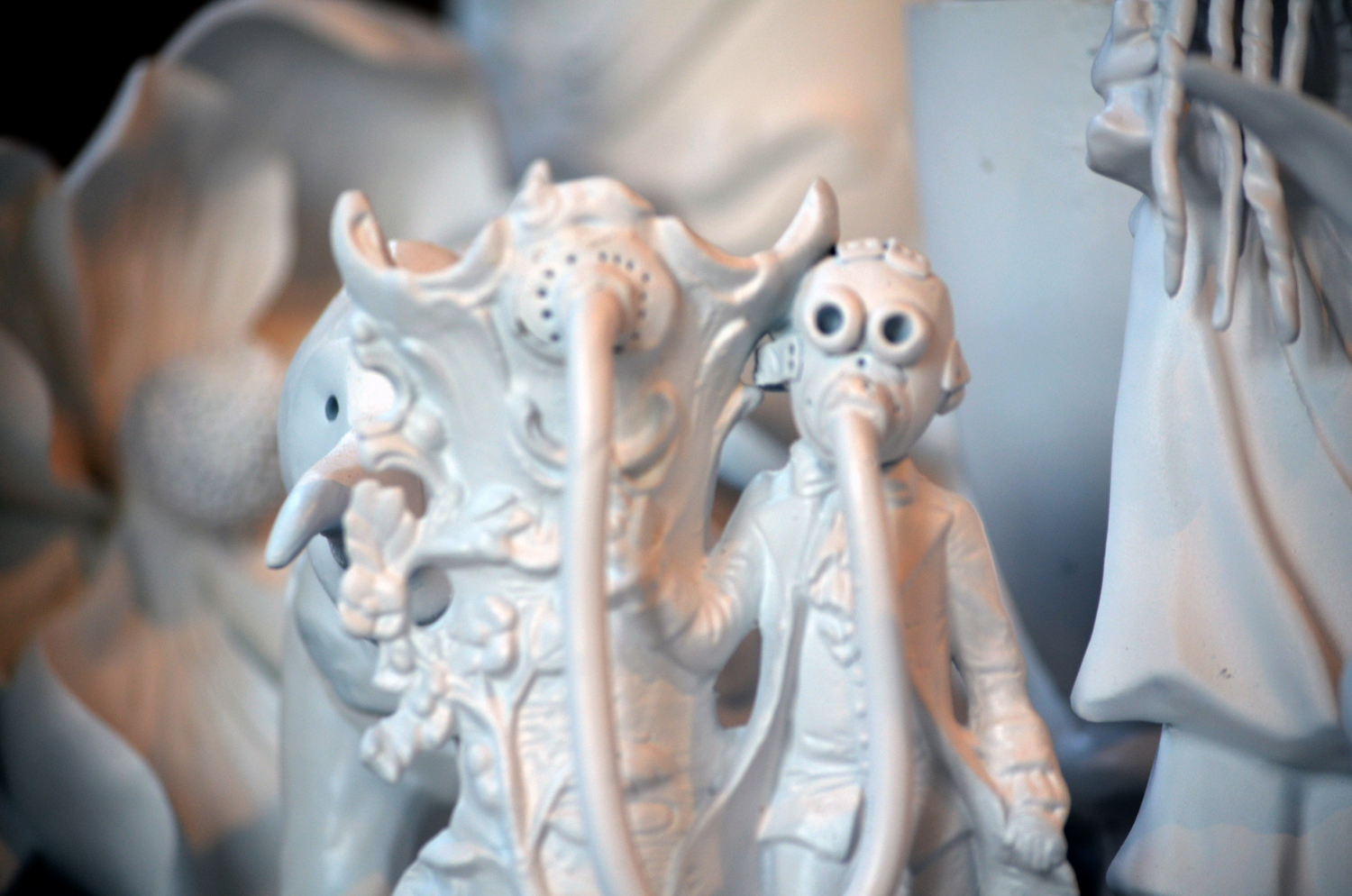
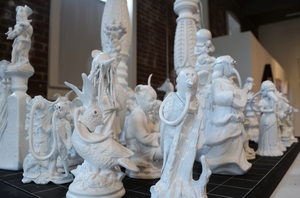

Remnants is an ongoing project that looks into tchotchkes—porcelain items left in thrift stores or antique
shops. I approach tchotchkes as found objects and as a source of material. Through fragmentation and
extraction of the original materiality and through reassembling porcelains together to create new artifacts,
a simulacra results that is distinctive from its original function and context. This project considers the
porcelain tchotchkes through Walter Benjamin’s concept of ruins: what survives and what remains are
ghostly experiences, out of place and out of context, their sacred notion is lost, only melancholies
alienated from the here and the now remain.
shops. I approach tchotchkes as found objects and as a source of material. Through fragmentation and
extraction of the original materiality and through reassembling porcelains together to create new artifacts,
a simulacra results that is distinctive from its original function and context. This project considers the
porcelain tchotchkes through Walter Benjamin’s concept of ruins: what survives and what remains are
ghostly experiences, out of place and out of context, their sacred notion is lost, only melancholies
alienated from the here and the now remain.

Finding the Baroque
Friday, May 6, 2016


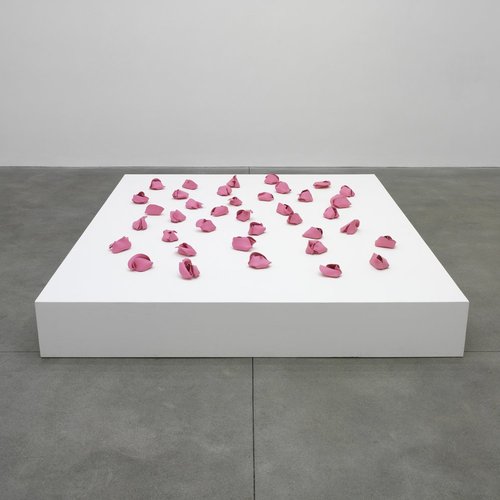
Hannah Wilke, American, b. 1940, d. 1993



 |
| Untitled, 60 ceramic objects, 1975 |


Wilke used the various mediums of photography, performance, sculpture, and video to examine and challenge prevailing notions of femininity, feminism, and sexuality. She was one of the first artists to use vaginal imagery in her work with the purpose of directly engaging with feminist issues. During the late 1950s through the early 1970s, Wilke worked on creating a type of female iconography based on the body, constructing abstract, organic forms that closely resembled female genitalia. She displayed these forms on the floor or wall in a highly organized and repetitious manner that recalled Minimalism. During the 1970s, she began to use her own body for performance pieces that she called her "performalist self-portraits." These performances, immortalized on video or in photographs, confront erotic stereotypes by calling attention to and making ironic the conventional gestures, poses, and attributes of the female body. In one well-known piece, the S.O S. Starification Object Series(1974–79), Wilke posed half-naked for a series of black-and-white photo stills, adopting the accoutrements and attitudes of female celebrities, but with her torso literally "scarred" with chewing gum shaped into tiny vulvas. The chewing gum interrupts the viewer's desiring gaze, calling attention to the objectification of woman's bodies. guggenheim.org
Thursday, May 5, 2016
Fred Wilson, American, b. 1954
| MINING THE MUSEUM Text excerpts from an essay by Elisabeth Ginsberg Source is beautifultrouble.org “What they put on view says a lot about a museum, but what they don’t put on view says even more,”[2] Wilson said in an interview about his installations. He communicated this point by contrasting what is with what should be. By drawing attention to the overlooked black figures, his installment asked whose truth was on display at the Maryland Historical Society.  |
The installation juxtaposed ornate silver pitchers, flacons, and teacups with a pair of iron slave shackles. Traditionally, the display of arts and craft is kept separate from the display of traumatic artifacts such as slave shackles. By displaying these artifacts side by side, Wilson created an atmosphere of unease and made apparent the link between the two kinds of metal works: The production of the one was made possible by the subjugation enforced by the other. When the audience made this connection, Wilson succeeded in creating awareness of the biases that often underlie historical exhibitions and, further, the way these biases shape the meaning we attach to what we are viewing.
|


Modes of Transport
Wilson communicated his critique through a strategic juxtaposition of the museum’s artifacts. The audience was left to draw the conclusions. Wilson exhibited an old baby carriage in which a Ku Klux Klan hood substituted the usual bedding. The baby carriage was placed next to a photograph of black nannies with white babies — their future employers. Again, Wilson did not make any explicit statements, but simply provided the audience with a strong visual statement about the persistence of racial hierarchies. The suggestion that children readily absorb their parents’ prejudices was clear.
Why it worked
There have been other attempts to use satirical techniques to critique museum institutions from within. Often these have caused controversies due to misinterpretations and the difficulties inherent in the ambition to destabilize one’s own foundation. “Mining the Museum” worked because it was suggestive rather than didactic, provocative rather than moralizing.


Love and Loss in the Milky Way, 2005
1 table with 47 milk glass elements, 1 plaster bust, 1 plaster head, 1 standing woman and a ceramic cookie jar,
77 3/4 x 92 x 43 7/8 inches.
Photo by Kerry Ryan McFate. Courtesy The Pace Gallery, New York.
Untitled. 2005.
1 table with 47 milk glass elements, 1 plaster bust, 1 plaster head, 1 standing woman and a ceramic cookie jar,
77 3/4 x 92 x 43 7/8 inches.
Photo by Kerry Ryan McFate. Courtesy The Pace Gallery, New York.
"...Love and Loss in the Milky Way is a subtle and moving assemblage that reflects on the fragility of human relations. Here, seventy-five pieces of milk glass—one of which belonged to Wilson’s late mother—are displayed on a tabletop. Among these vessels are four sculptural elements: a standing Greek figure, the bust of a black woman with an elongated neck, a mammy-type figurative cookie jar, and a broken plaster bust of a white male, modeled on a classical Roman prototype. The work suggests an encounter between various cultures and alludes to the relationship between fine art and material culture. Yet the figures here are not just true to type. The way in which they face one another, with the white male figure lying broken among them, suggests a more philosophical response than one expects from Wilson. No longer does the artist attempt to embody one of these representations. Instead, he approaches his subject from a distance; viewers may sense that the real story lies among these pieces, in the gaps between races, ideas about race, and the way those are fixed in objects."
March 14, 2012 artpractical.com |
| Fred Wilson |
Cornelia Parker, b. 1956, United Kingdom


1988 -89
Thirty Pieces of Silver comprises over a thousand flattened silver objects, including plates, spoons, candlesticks, trophies, cigarette cases, teapots and trombones. All the objects were ceremoniously crushed by a steamroller at Cornelia Parker’s request. She then arranged the transformed silver artefacts into thirty disc-shaped groups, which are suspended about a foot from the floor by hundreds of fine wires. Each ‘disc’ is approximately ninety centimetres in diameter and they are always hung in orderly rows, although their overall configuration is adapted each time to the space in which the work is displayed. The title refers to the biblical story of how the apostle Judas Iscariot betrayed Jesus in return for thirty pieces of silver.
tate.org.uk
 |
| Cornelia Parker |


Saturday, April 30, 2016
Materials and Processes
Make It Yourself
Processes
Paper and Gesso
Trace Paper and Gel Medium
Paper construction
Paper mold
Low Cost/Free Materials
Newspaper
Can paint it.
Large rolls of craft paper
Twist it, roll it, pack it. We usually have rolls in art building.
Wood
Plenty of scrap wood in the wood shop
Wood Cooking Skewers
Can purchase a lot for cheap at grocery store - all sorts of uses.
Wire
Need wire cutters and protective eyewear.
Balsa Wood
Easy to cut with a utility knife or in wood shop. Sold in art supply stores.
Grocery bags (paper and plastic)
Can be twisted for strength.
The following materials require instructor approval:
Plaster
Must wear face mask, gloves, protective eyewear. Use material outside in designated area.
Resin
Must wear face mask, gloves, protective eyewear. Use material outside in designated area.
Latex
Must wear face mask, gloves, protective eyewear. Use material outside in designated area.
- Paper Clay (Can also purchase in art supply stores - more money for smaller amount. A lot of recipes on-line.)
- Air Dry Porcelain Clay (Again, a lot of recipes on-line)
Processes
Paper and Gesso
Trace Paper and Gel Medium
Paper construction
Paper mold
Low Cost/Free Materials
Cardboard
Clark Appliances, corner of Carerra and US 1 has a surplus of cardboard that they will give you.
Clark Appliances, corner of Carerra and US 1 has a surplus of cardboard that they will give you.
Newspaper
Can paint it.
Large rolls of craft paper
Twist it, roll it, pack it. We usually have rolls in art building.
Wood
Plenty of scrap wood in the wood shop
Wood Cooking Skewers
Can purchase a lot for cheap at grocery store - all sorts of uses.
Wire
Need wire cutters and protective eyewear.
Balsa Wood
Easy to cut with a utility knife or in wood shop. Sold in art supply stores.
Grocery bags (paper and plastic)
Can be twisted for strength.
The following materials require instructor approval:
Plaster
Must wear face mask, gloves, protective eyewear. Use material outside in designated area.
Resin
Must wear face mask, gloves, protective eyewear. Use material outside in designated area.
Latex
Must wear face mask, gloves, protective eyewear. Use material outside in designated area.
Saturday, April 23, 2016


Subscribe to:
Posts (Atom)