Translate

Showing posts with label Student Work Installation. Show all posts

Friday, August 21, 2020

Sasha Lute, Student Work


This installation represents parts to a whole system by utilizing windows to see into "rooms" that housed scenes of miniatures of furniture, noses, ears, lips, and hands. The installation to me portrays pieces of a whole person and the little things that make us who we are. I began by making several miniature clay body parts that I sculpted by hand to create molds. I built a faux wall that fit into a small space in the art building. This way my abstract formation of a person could physically take up and claim its own space, ceiling, walls, and floors.


Saturday, September 1, 2018

Annie Thompson, Student Work


“Somewhat Alive”

My intention is to create an experience that appears subtle while conveying a sense of power.
The draped fabric appears quite and subtle. The shades of pink create a monochromatic atmosphere
of fleshy life. The sheets are connected to an inner motor so that every few moments both forms
pulsate at their own rhythm. Sporadic thuds can be heard as the mechanism turns.This installation
creates a delicately engaging interaction with the viewer, as its calls attention to itself if the
viewer is willing to stop and experience the limited movement.

Materials:
Cotton fabric
Rotisserie chicken motors
Wood
Wire

Installed in Molly Wiley Art Building, Flagler College, St. Augustine, Florida
4' x 7' x 3'


 View from first floor of art building.


Wednesday, May 3, 2017

Joseph Provenza, Student Work


Mom
Fabric, paint, lazer prints, frame, artificial light.
3.5' x 7' x 3'


Kimmy Schander, Student Work


"Reflecting on Man Draining Nature: Diffract, Refract, Reflection" 

48" X 48" X 108"

Found tree trunk with PVC pipe embedded, more PVC pipes, tree branches, wrapping paper, assorted glass jars, water, glycerin, glass rods, and red acrylic paint

Statement:
After I gathered all my materials, I sat in the space with my tree trunk and pipes, allowing the three walls to surround me. I wanted it to shape my emotions, somehow, and incorporate my thoughts on nature. I was still reflecting on how light bends objects through water, too....and then the pipes spoke out! I immediately thought about how we are draining nature, and began incorporating all my previous ideas, and this one, into a whole new one. My goal being,  that my viewers would grasp a similar experience because our Earth's natural resources are diminishing,  and man is to blame. Winifred Gallagher called it "The Science of experience" in "The Power of Place. Yes, we need to reflect on how man is draining nature. We need to diffract from our current ways refracting in the light of nature. . .bending with the waters of willpower, and change our wasteful ways, before we drain her dry. 


Saturday, February 4, 2017

Hope Delemeester, Student Work, Installation


Statement:
The theme for this piece is "what was left behind". Chuck Palahniuk's book Doomed served as inspiration. I set out to create my version of Hell in the form of a prison cell. My hell consists of black walls, a perfectly egg shell white desk, a never ending supply of king size candy bars and a telemarketing phone I'm forced to use. On top the desk I placed a brochure in the form of a welcome packet to the "Last Job of You'll Ever Have", a "Map of Hell" and a list of "Specific Useless Questions" to interrupt happy families sitting down to eat. 

Black, plastic garbage bags lined the walls, ceiling and floor. I designed "prison bars" out of wood dowels that I painted silver and hung from the wall with hooks. I also built the desk and designed the brochure and map on the computer.  The viewer was not able to enter the space. Rather, the viewer had to peer through the bars to examine the contents. 


Setting up lights (from upstairs photo studio) to take professional images. 


Ellie Wools, Student Work, Installation


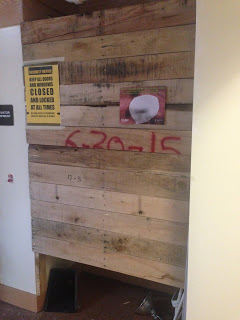
This piece was meant to evoke a certain level of anxiety. I boarded up a small alcove in the art building, leaving only a glimpse of what was behind the boards. I included sound in the form of a florescent bulb buzzing to enhance the anxiety. 


Friday, May 6, 2016

FOOD LOVE

A Community Engaged Project 
April 3, 2015
Markland House Lawn
Flagler College Campus
St. Augustine, Florida


Students enrolled in my Installation and Site Specific class hand fed strangers in an intimate setting while telling personal stories. Each student prepared a meal that was nostalgic to them. Guests were seated in a tent with a fabric divider down the middle. Guests and students could not see each other. Guests were asked not to speak, simply listen and taste. Once the guest was seated, the student gently offered a taste of food by holding out a spoon/fork underneath the fabric divider. As the student fed the guest, a story was told about the memories associated with the food they had chosen to prepare. The interior of the tents were lit with white holiday lights and each student placed personal items and photos in the tent. Each guest spent approximately 10 - 15 minutes in the tent. At the end of each session, guest and student touched hands.

FOOD LOVE encompassed all the senses.
Sound. Voices whispering stories and the soft strumming of guitar.
Scent. The aroma of food being cooked and served.
Taste. Small bites of food for the palette.
Touch. The pulling back of fabric to enter the tent and a goodbye touch to the hand.
Sight. The event officially began when the sun set. The white tents glowed in the darkness under the large oak trees.

Reservations were made weeks ahead of time. The event was free and open to the public.

The students and myself designed, constructed and installed the tents. I would like to thank Russell Maycumber II, Russell Maycumber III, Luciana Gassett, Flagler College Maintenance staff, Laura Stevenson-Dumas and Holly Hill.


Sunday, April 24, 2016

Nicki Smith, Student Work


Artist Statement:

This piece was inspired by the concept of mental illnesses and how only the person going through it is the one who truly understands it. Even then, they may not understand what they're going through entirely. A major inspiration for this piece was the book and movie One Flew Over the Cuckoo's Nest. The fog that the main character deals with and the ambiguous clarity that it lacks intentionally to make you think and try to understand. This piece can resonate with everyone differently. When I began the installation, it was to capture the emotions of a schizophrenic person. After a bit, I began to connect with the work in a different way  - as if the eyes were people and watching me.  There's a clear distress and uneasy situation going on, but the actual explanation of what is going on is left up to the viewer.


Details


Foam Board Models


Monica Stauffer, Student Work


Synesthesia | Natural History of the Senses

Artist Statement
Synesthesia is the the production of a sense impression relating to one sense or part of the body by stimulation of another sense or part of the body. The most basic example is seeing letters or numbers in a certain color, or identifying certain sounds with colors as well (low sounds are dark colors, high sounds are light colors). It’s a union of the senses, a sensory overload, a luminous spill of sensation. It’s caused by the limbic system not being governed by the cortex. 
Many creatives have this; it allows them to have the ability to create a piece of art that conveys an emotion. It also can act as a sort of mnemonic device, to help aid in remembering an idea, or sparking a thought (sex, tea, cigars, and baths are all historical examples). 
Experiencing synesthesia is a very personal thing, and differs from person to person. However, there are daily occurrences of synesthesia in almost every person. 
When you walk into a building, you usually experience a change in your mental or emotional state. Entering a church gives this sense of holiness, of grandeur, because of it’s size as well as ornamentation. However, this is a completely different experience than you feel when you walk into a house, particularly your home. Your home is your safe haven, where you feel most like yourself, where you return to to remember who you are. It’s comfortable, and most likely does not leave you with the feeling of divinity. 
Physical spaces have an emotional impact on us. The way a space is designed and laid out causes this impression. And that is what I set out to do with this installation: create a physical space that, upon entrance, causes you to feel calm and collected, contained, yet still a part of the world. 
The other goal was to draw attention to an architectural feature. The site that the installation was set up in has a wooden beam coming down from the highest point to the corner in this alcove. It seemed the perfect thing to draw attention to, to mimic. 
The purpose of the thread is to lead the eye of the viewer to this corner: the eye moves in, and then up. It pulls you in, as numerous lines lead to this point. That is how the viewer ends up being in the space. Once in the space, the numerous angles of the thread create a sort of wall, making the viewer feel enclosed, yet not to the point of being separate from the world. It’s calming, a space to be in when you don’t wan to escape completely. 
The physical appearance and experience of the space cause an emotional and mental connection with the viewer, achieving synesthesia.