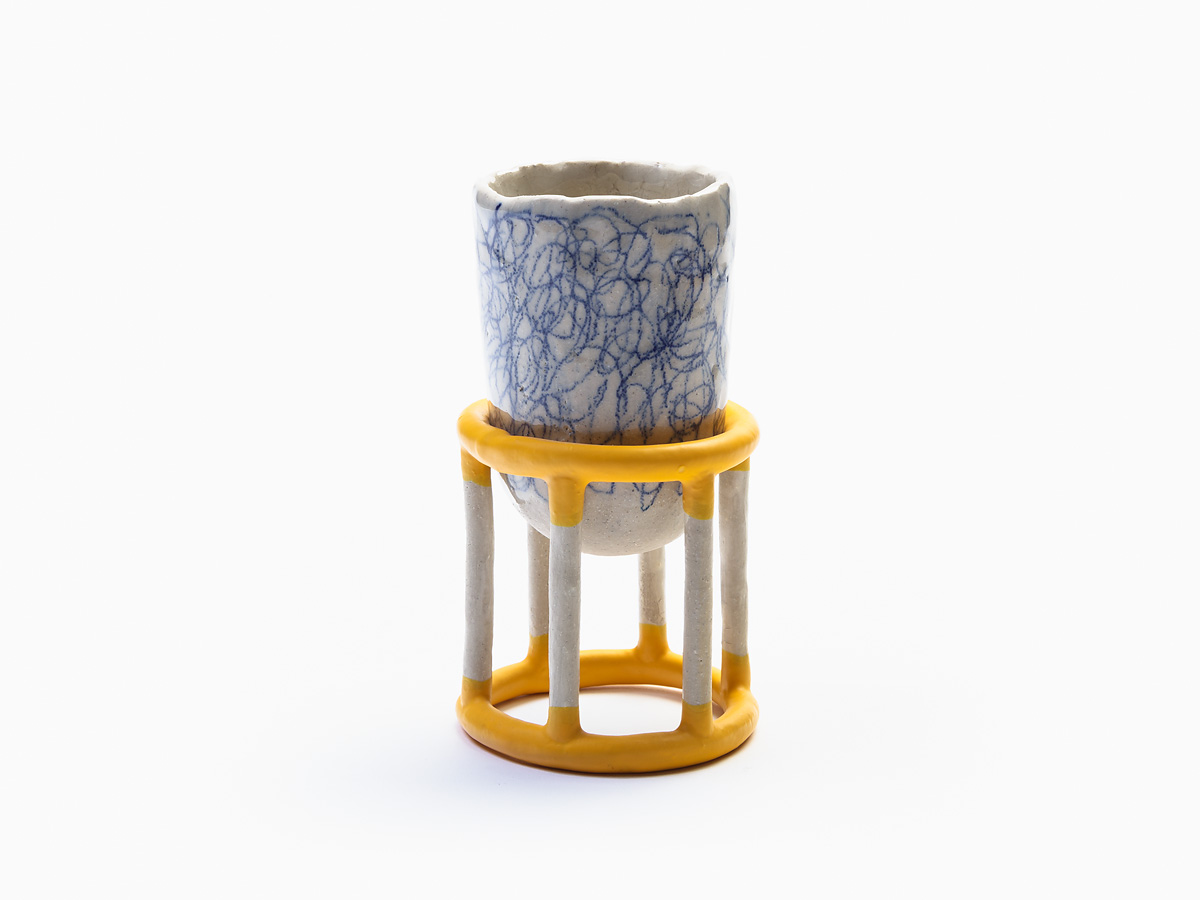
See more ceramic work by the artist at link below.

See more in process images by the artist at link below.


I resist acknowledging that the objects inhabiting our lives are inanimate. By considering the objects’ needs, and denying our needs for those objects, they can expose a life and language of their own. A stack of books hidden by a blanket of dust waits patiently to fulfill its purpose. The books appear to be aged and desolate, yet shielded and protected by time and neglect. By carefully observing the relationships between the things around us, I have found them to reveal their physical and psychological states that often go unnoticed. In this realm, objects are personified, perception is ever changing, and things become their true self.
More work to see. Go to Art Axis link:


My ceramic sculptures are physical representations of our psychological incongruities: the doubts, questions, and shifts in perspectives through which we view the memories of our lives. The act of reflecting upon our experiences can often become an investigation, a system of discovering and constructing underlying emotional structures. I find that a memory’s ability to mutate—to restructure reality or to erode the truth—is a potent source of inquiry for my work.
The sculptures appear soft and pliable, yet they are hardened and permanent objects in space. This perceived softness relates to the flesh of the body in order to connect with our innate humanness and the malleable perception of our memories. The use of materials such as wood and concrete creates a physical and psychological intimacy around a space that is associated with home, structure and shelter. The making process involves a conscious act of piecemeal construction; building as needed to conceal or support the centralized ceramic form. Their fixed state serves as a means to document a single instance of a recalled event, to create a calcified moment of the past. Through various ambivalent postures, props, and subtle comparisons, the forms evoke a curiosity, a desire to empathize with their conflicting state.
-- Sara Allen Prigodich
See more work on Art Axis:

Intuitively the works respond to the Himalayan landscape, drawing on a certain sense of self experienced when walking through the mountains and encountering something ancient, mystical, magical and timeless. While the time-worn textures and iconographic markings on the surfaces may appear to reference established traditions, through my working process the text, icons and imagery are remixed and re-contextualized into new works that are symbolic without being derivative, accessible yet also contemplative. The work walks a line between the meditative and the playful, questioning perceived boundaries between Spirit and Matter. Often they are inspired by the phenomenon of street shrines for all over the Indian subcontinent, where associations of faith - often contested - have the ability to transform the meaning of ordinary objects.
-- Vineet Kacker
To see more work, link to Art Axis:


Principally, the time and labour involved in producing this work is where its conceptual basis lies. The objects have been created in comparative reference to the stones that cover and surround the railway, which was used as the main mode of prisoner transportation into the Auschwitz II (Birkenau) extermination camp. Utilising a wide range of clay types and a process completely reliant on the hands of the artist; I have produced each ceramic ‘stone’ to feature a fingerprint: an index of human interaction. This is intended as both a reductive exercise in considering the treatment of those victimised, but also as a way to create retrospective evidence. This evidence demonstrates that beyond the surface of largely incomprehensible statistics, is the reality of lived and felt human history.
The work is presented as two separate beds of ceramic ‘stones’. One bed contains 1.1 million pieces, and the other; 200,000 pieces. This gives a direct visual reference to the number of deaths (1.1 million) compared with those who survived the Auschwitz camps (200,000).
Aesthetically, the installation is reminiscent of the railway leading through the main entrance of Auschwitz II, also known as 'the death gate’. Various elements of the work, including the colour ratio of chosen clay types and the size of the ceramic ‘stones’ directly respond to personal impressions and reference images taken while visiting the Auschwitz camps in January 2016. In no way does the work aim to wholly represent what was experienced by those victimised, but instead, references the history from an overarching and reflective standpoint. It is by attempting representation that I wish to invoke an imaginative sense of totality.
Alongside the reference to a railway line, the objects I have created acknowledge a Jewish tradition that involves placing stones on grave-sites. This practice has been interpreted in various ways but is commonly considered as a way to honour those lost. This is through an object which, unlike flowers that wither and die, encourages the metaphorical idea of permanence as it applies to remembering.
On June 28, 2015, I began developing this project and produced the first ceramic ‘stone’. This determined the completion date for Deathgate to be on November 21, 2018. Totalling 1,242 days or 3 years, 4 months and 24 days, the start-to-finish production of Deathgate directly corresponds with the mass killing of prisoners in the Auschwitz network of camps, where the first large-scale gassing of prisoners occurred on September 3, 1941, and ensued in various forms until the liberation of Auschwitz on January 27, 1945.
I intend for the work to not just reference those detained in the Auschwitz camps, but to be considered as a relative fraction of the total amount of Holocaust victims (6 million). The work aims to memorialise this unconscionable event while questioning the role of art in remembering such history. More broadly, the work speaks of abhorrence and the ongoing nature of prejudice, discrimination and genocide. If anything, the crucial intent of the work is for it to act as a contemplative agent and an exercise in empathy, both for myself and viewers alike.
An digital version of the self-published catalogue for this artwork can be viewed here, which includes process and original reference photographs, an essay by artist, art critic and theorist Sandy Pottinger and a foreword by Dr Lachlan Malone.
Artist Website: