Translate

Showing posts with label Expose and Comment Research. Show all posts

Sunday, May 14, 2017

Melissa Vandenberg, Artist, American


Braided Rapunzel 
US flags, steel, flag pole base & mannequin head 
2016, variable dimensions


Snake Handler 
gloves, polyester, thread, buttons, bell, mirror & wood 
2016, 31 x 74 x 28 inches


Sink or Swim: Family Style 
US Flags, Kapok life vests, wood & hardware 
2012, 12 x 36 x 27 inches


Forget Me (k)Not 
handkerchiefs, sewing notions, sewing machine & hardware 
2014, variable dimensions, Lexington Art League (interior)


Forget Me (k)Not 
handkerchiefs, sewing notions, sewing machine & hardware 
2014, variable dimensions, Lexington Art League (exterior)


Tuesday, May 9, 2017

Nicole Gugliotti, Artist, United States


awe/agency

Porcelain, Stoneware, wood, paint, video projection, audio, monofilament. 

10 ft. x 25 ft. x 14 ft. area installed


Images of the gallery exhibition can be seen here.  You can also see and hear the video and audio that was included in the installation.
Despite being legal in the united states, portrayals of abortion in pop culture and politics would have us believe that the choice is only acceptable when the alternative is self-destruction or worse. Rarely is abortion portrayed as a smart, brave decision. People who have had abortions are cast as villains or, more benevolently, victims and rarely as heroes of their own story. AWE/AGENCY seeks to combine formal beauty and wonder with pointed, direct content with the intent of offering an alternative model to the dominant narrative surrounding abortion in the U.S. 
Nicole Gugliotti is an artist and abortion services worker.  


Organic shapes  made of clay serve as speakers that cradle the head when participants lean in to hear recorded personal stories. 


Kara Walker, Artist, b. 1969, American


The Sugar Sphinx,” by Hilton Als. Kara Walker’s bleached-sugar sphinx is triumphant, rising from a kind of half-world—the shadowy half-world of slavery and degradation.

Walker knows that ghosts can hurt you because history does not go away. Americans live, still, in an atmosphere of phantasmagorical genocide—we kill each other with looks, judgments, the fantasies that white is better than black and that blackness is bestial while being somehow more “humane”—read mentally inferior—than whiteness. But what do those colors even mean? In Walker’s view, they are signifiers about power—the power separating those who have the language to make the world and map it, and those who work that claimed land for them with no remuneration, no hope, and then degradation and death.

Located in Williamsburg, the Domino Sugar Factory was built in 1882; by the eighteen-nineties, it was producing half the sugar being consumed in the United States. As recently as 2000, it was the site of a long labor strike, in which two hundred and fifty workers protested wages and labor conditions for twenty months. (I saw the piece before the installation was complete and look forward to going back.) Now the factory is about to be torn down and its site developed, and its history will be eradicated by apartments and bodies that do not know the labor and history and death that came before its moneyed hope. The site is worth mentioning at length because Walker’s creation is not only redolent of its history, it’s of a piece with the sugar factory—and its imminent destruction.

Measuring approximately seventy-five and a half feet long and thirty-five and a half feet high, the sculpture is white—a mammy-as-sphinx made out of bleached sugar, which is a metaphor and reality. Remember, sugar is brown in its “raw” state. Walker, in a very informative interview with Kara Rooney, says that she read a book called “Sweetness and Power: The Place of Sugar in Modern History.” There, she learned that sugar was such a commodity that, in the eleventh century, marzipan sculptures were created by the sultans in the East to give to the poor on feast days. This tradition made its way to Northern Europe, eventually, where royal chefs made sugar sculptures called subtleties. Walker was taken not only with those stories but with the history of the slave trade in America: Who cut the sugar cane? Who ground it down to syrup? Who bleached it? Who sacked it?

Above text source from Culture Desk, by Hilton Als, The New Yorker. Link here to read full article. 


Auntie Walker’s Wall Sampler for Savages, cut paper on wall, and Burning African Village Play Set with Big House and Lynching, 2006, painted laser-cut steel, with Erin Shirreff, photographs and sculptures, installation at Sikkema Jenkins & Co.

Adriane Colburn, Aritst, based in San Francisco and New York


Forest for the Trees


2010
Inkjet prints, sumi ink, film
12'x7'
Forest for the Trees is a meditation on the complex relationship between nature and industry; sustained land vs. commodified land; matter on the surface of the earth vs. the matter below ground; the morphing of the forest into an industrial landscape; and the fines lines between use and exploitation.

Yank Shonibare, Artist, b. 1962, London


'Mrs Pinckney and the Emancipated Birds of South Carolina' 2017

ENLIGHTENED PRINCESSES: CAROLINE, AUGUSTA, CHARLOTTE, AND THE SHAPING OF THE MODERN WORLD

THURSDAY 2ND FEBRUARY - SUNDAY 30TH APRIL, 2017

Specially commissioned new artwork by Yinka Shonibare MBE: Mrs Pinckney and the Emancipated Birds of South Carolina, 2017
Exhibition: Enlightened Princesses: Caroline, Augusta, Charlotte, and the Shaping of the Modern World at Yale Center for British Art
This exhibition will explore the story of three remarkable German princesses: Caroline of Ansbach, Augusta of Saxe-Gotha, and Charlotte of Mecklenberg-Strelitz, all of whom married into the British royal family in the eighteenth century. Caroline and Charlotte became queens consort to George II and George III respectively; Princess Augusta never achieved this distinction but held the titles of Princess of Wales and Princess Dowager, and was mother to King George III.
Through their wide-ranging intellectual, social, and political interests, Caroline, Augusta, and Charlotte helped to shape court culture and the age in which they lived, and would leave a lasting legacy. They encouraged the greatest philosophers, scientists, artists, and architects of the day; and they brought art, music, dance, enlightened conversation, and experimentation into the palaces and royal gardens, and supported industry, trade, and imperial ambition. The exhibition will include many important works of art and manufacture, which belonged to these women and their families, or were commissioned by them. Works by Hans Holbein, William Kent, Allan Ramsay, Sir Joshua Reynolds, George Stubbs, Thomas Gainsborough, Johan Zoffany, and many more will be on display. Enlightened Princesses: Caroline, Augusta, Charlotte, and the Shaping of the Modern World is a collaboration between Historic Royal Palaces and the Yale Center for British Art. It will be on view at the Center in spring 2017 and then at Kensington Palace from June 22 to November 12, 2017. The lead curator is Joanna Marschner, Senior Curator at Historic Royal Palaces, assisted by Samantha Howard, Curatorial Assistant. The organizing curator at the Center is Amy Meyers, Director, who is assisted by Lisa Ford, Assistant Director of Research; Glenn Adamson, Senior Research Associate; and Tyler Griffith, Postdoctoral Research Associate.
The exhibition will be accompanied by a publication of the same title, a beautifully illustrated catalogue of works edited by Joanna Marschner, with the assistance of David Bindman and Lisa Ford. Co-published with Historic Royal Palaces in association with Yale University Press, the book will feature contributions by an international team of scholars.


Bio
Yinka Shonibare MBE was born in 1962 in London and moved to Lagos, Nigeria at the age of three. He returned to London to study Fine Art, first at Byam School of Art (now Central Saint Martins College) and then at Goldsmiths College, where he received his MFA.
Shonibare’s work explores issues of race and class through the media of painting, sculpture, photography and film. Shonibare questions the meaning of cultural and national definitions. His trademark material is the brightly coloured ‘African’ batik fabric he buys in London. This type of fabric was inspired by Indonesian design, mass-produced by the Dutch and eventually sold to the colonies in West Africa. In the 1960s the material became a new sign of African identity and independence.
Shonibare was a Turner prize nominee in 2004, and was also awarded the decoration of Member of the ‘Most Excellent Order of the British Empire’ or MBE, a title he has added to his professional name. Shonibare was notably commissioned by Okwui Enwezor at Documenta 11, Kassel, in 2002 to create his most recognised work ‘Gallantry and Criminal Conversation’ that launched him on to an international stage. He has exhibited at the Venice Biennale and internationally at leading museums. In September 2008, his major mid-career survey commenced at the MCA Sydney and then toured to the Brooklyn Museum, New York and the Museum of African Art at the Smithsonian Institution, Washington DC. He was elected as a Royal Academician by the Royal Academy, London in 2013.
Shonibare’s work, ‘Nelson’s Ship in a Bottle’ was the 2010 Fourth Plinth Commission, and was displayed in Trafalgar Square, London, until January 2012. It was the first commission by a black British artist and was part of a national fundraising campaign organized by the Art Fund and the National Maritime Museum, who have now successfully acquired the sculpture for permanent display outside the museum's new entrance in Greenwich Park, London.
In 2012, the Royal Opera House, London, commissioned ‘Globe Head Ballerina’ (2012) to be displayed on the exterior of the Royal Opera House, overlooking Russell Street in Covent Garden. The life-sized ballerina encased within a giant ‘snow globe’ spins slowly as if caught mid-dance, the piece appears to encapsulate a moment of performance as if stolen from the stage of the Royal Opera House.
In 2014, Doughty Hanson & Co Real Estate and Terrace Hill, commissioned ‘Wind Sculpture’ and it is installed in Wilcox Place, London. Measuring 6 metres by 3 metres, it explores the notion of harnessing movement through the idea of capturing and freezing a volume of wind in a moment in time.
Shonibare’s works are included in prominent collections internationally, including the Tate Collection, London; Victoria and Albert Museum, London; National Museum of African Art, Smithsonian Institute, Washington, D.C; Museum of Modern Art, New York; National Gallery of Canada, Ottawa; Moderna Museet, Stockholm; National Gallery of Modern Art in Rome and VandenBroek Foundation, The Netherlands.

Sunday, May 22, 2016

Rodney McMillian, b. 1969, USA

From Asterisks in Dockery, 2012By presenting rather than representing, exposing rather than obscuring, McMillian’s work might seem in direct opposition to the idea of illusion.

While this might be true of the work itself, McMillian accomplishes the great feat of destabilizing many of the illusions our society relies on for its survival.


We consider our private spaces to be sacred, but they are not isolated from the racist rhetoric and policies that come from the top of the political order. 


Our leaders assure us that we have come a long way, but racism and inequality persist to this day in ever-evolving ways. McMillian shows us that progress—like comfort, safety, and stability—is an illusion.
Above images and text source blog.art21.org


From Asterisks in Dockery, 2012
Red Vinyl


Untitled (2009)
 McMillan has impaled a familiar IKEA chair with a giant black tube—evoking a sort of industrial-scale phallus enacting sexual violence against a mainstay of bourgeois décor. 

For Couch (2012)
McMillan severed a sateen sofa and pasted it together with a thick band of cement. 


Wednesday, May 11, 2016

Edgar Endress, Artist


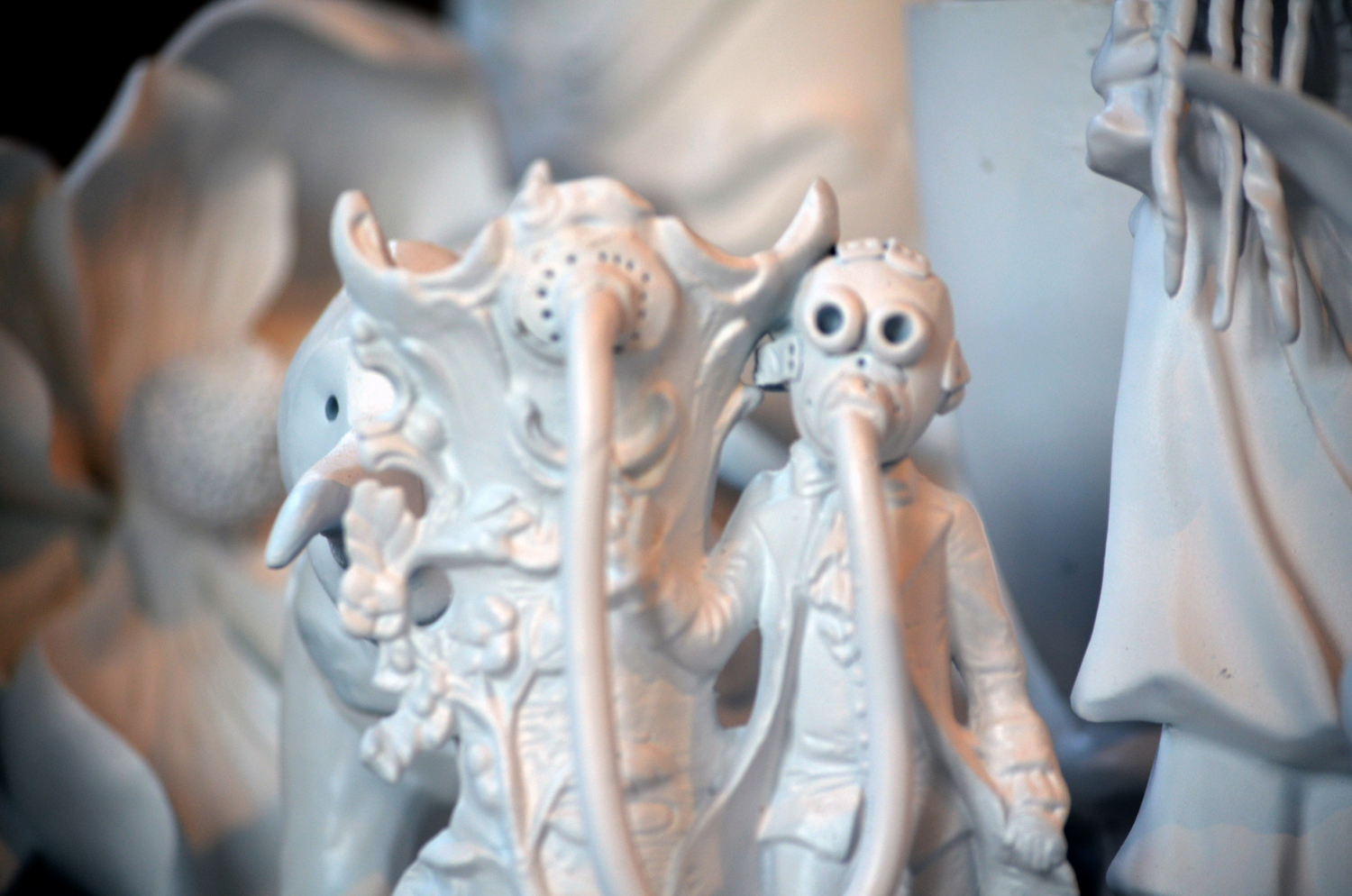
Remnants is an ongoing project that looks into tchotchkes—porcelain items left in thrift stores or antique
shops. I approach tchotchkes as found objects and as a source of material. Through fragmentation and
extraction of the original materiality and through reassembling porcelains together to create new artifacts,
a simulacra results that is distinctive from its original function and context. This project considers the
porcelain tchotchkes through Walter Benjamin’s concept of ruins: what survives and what remains are
ghostly experiences, out of place and out of context, their sacred notion is lost, only melancholies
alienated from the here and the now remain.  


Finding the Baroque

Tuesday, May 10, 2016

Greg Lookerse, Artist, American


Over the course of seven hours and forty six minutes I broke five loaves of bread into 5000 pieces with a few crusts left over. The piece took place within a translucent structure. Thousands of small crumbs were lost through the cracks in the floor of the structure.

greglookerse.com

Thursday, May 5, 2016

Fred Wilson, American, b. 1954

MINING THE MUSEUM
Text excerpts from an essay by 
Source is beautifultrouble.org

“What they put on view says a lot about a museum, but what they don’t put on view says even more,”[2] Wilson said in an interview about his installations. He communicated this point by contrasting what is with what should be. By drawing attention to the overlooked black figures, his installment asked whose truth was on display at the Maryland Historical Society.


Metalwork 1793–1880
The installation juxtaposed ornate silver pitchers, flacons, and teacups with a pair of iron slave shackles. Traditionally, the display of arts and craft is kept separate from the display of traumatic artifacts such as slave shackles. By displaying these artifacts side by side, Wilson created an atmosphere of unease and made apparent the link between the two kinds of metal works: The production of the one was made possible by the subjugation enforced by the other. When the audience made this connection, Wilson succeeded in creating awareness of the biases that often underlie historical exhibitions and, further, the way these biases shape the meaning we attach to what we are viewing.


Modes of Transport
Wilson communicated his critique through a strategic juxtaposition of the museum’s artifacts. The audience was left to draw the conclusions. Wilson exhibited an old baby carriage in which a Ku Klux Klan hood substituted the usual bedding. The baby carriage was placed next to a photograph of black nannies with white babies — their future employers. Again, Wilson did not make any explicit statements, but simply provided the audience with a strong visual statement about the persistence of racial hierarchies. The suggestion that children readily absorb their parents’ prejudices was clear.


Why it worked
There have been other attempts to use satirical techniques to critique museum institutions from within. Often these have caused controversies due to misinterpretations and the difficulties inherent in the ambition to destabilize one’s own foundation. “Mining the Museum” worked because it was suggestive rather than didactic, provocative rather than moralizing.

Wilson’s intervention was a correction of the museum’s identity in the sense that it made the underlying racism apparent. Using glass cases and neat labeling, Wilson’s installations mimicked the usual methods of museum display but with a twist so that a new voice or persona was created. As he said it himself: “By bringing things out of storage and shifting things already on view, I believe I created a new public persona for the historical society.”


Love and Loss in the Milky Way, 2005
1 table with 47 milk glass elements, 1 plaster bust, 1 plaster head, 1 standing woman and a ceramic cookie jar, 
77 3/4 x 92 x 43 7/8 inches. 

Photo by Kerry Ryan McFate. Courtesy The Pace Gallery, New York.


 Untitled. 2005. 
1 table with 47 milk glass elements, 1 plaster bust, 1 plaster head, 1 standing woman and a ceramic cookie jar, 
77 3/4 x 92 x 43 7/8 inches. 
Photo by Kerry Ryan McFate. Courtesy The Pace Gallery, New York.

"...Love and Loss in the Milky Way is a subtle and moving assemblage that reflects on the fragility of human relations. Here, seventy-five pieces of milk glass—one of which belonged to Wilson’s late mother—are displayed on a tabletop. Among these vessels are four sculptural elements: a standing Greek figure, the bust of a black woman with an elongated neck, a mammy-type figurative cookie jar, and a broken plaster bust of a white male, modeled on a classical Roman prototype. The work suggests an encounter between various cultures and alludes to the relationship between fine art and material culture. Yet the figures here are not just true to type. The way in which they face one another, with the white male figure lying broken among them, suggests a more philosophical response than one expects from Wilson. No longer does the artist attempt to embody one of these representations. Instead, he approaches his subject from a distance; viewers may sense that the real story lies among these pieces, in the gaps between races, ideas about race, and the way those are fixed in objects." 
March 14, 2012 artpractical.com


Fred Wilson


Saturday, April 23, 2016

Krzysztof Wodiczko, Artist, b. 1943, Poland

"The Tijuana Projection," 2001
Public projection at the Centro Cultural de Tijuana, Mexico 
(as part of In-Site 2000)
© Krzysztof Wodiczko
"These very young women (the overwhelming number are young women) work in ways we don’t even imagine. Their situation is incomparably worse than anything I have tried to understand before. But I seem to be working with people who manage to survive and heal themselves to the point where they can take advantage of my projects to make another leap towards reconnecting with society."
- Krzysztof Wodiczko


Part of a several-months long public art festival on both sides of the Mexican-American border. 
Occurred in real time, several evenings, three hours each evening. 
500 factories in city (border factories). 
Materials shipped in for cheap labor. Shipped out all over world.
Young women provide 90% of this labor. 
Female becomes head of household (come with social implications).
Six women from various generations agreed to speak their stories. 
Face project on large sphere above crowds.
Voice amplified with speakers. 
Stories - domestic and sexual abuse, police violence, exploitation in the work place. 
Demonstrates a passage - private confession to public testimony. 
Purpose - seeking  moral and political change. 


Guests Polish Pavilion at the 
53rd International Art Exhibition in Venice


The protagonists of Krzysztof Wodiczko's projection in the Polish Pavilion at the 53rd Venice Art Biennial are immigrants, people who, not being 'at home', remain 'eternal guests'. 'Strangers', 'others' are key notions in Wodiczko's artistic practice, be it in the projections, the Vehicles, or the technologically advanced Instruments that enable those who, deprived of rights, remain mute, invisible and nameless to communicate, gain a voice, make a presence in public space.

The projection, created specially for the Biennial, transforms the space of the Polish Pavilion into a place where the viewers watch scenes taking place seemingly outside, behind an illusion of windows, their projection on the pavilion's windowless walls. The individual projections, the images of windows projected onto the pavilion's architecture, open its interior to virtual, but at the same time real, scenes showing immigrants washing windows, taking a rest, talking, waiting for work, exchanging remarks about their tough existential situation, unemployment, problems getting their stay legalised. The slight blurriness of the images reduces the legibility of the scenes taking place behind milky glass. Wodiczko plays with the visibility of immigrants, people who are 'within arm's reach' and, at the same time, 'on the other side', referring us to their ambivalent status, their social invisibility. Both sides experience an inability to overcome the gap separating them. The Biennial visitors are 'guests' here too, of which they are reminded by the images of immigrants trying, from time to time, to peek inside.

The project, dealing with the multicultural problematique of alterity, concerns one of the most burning issues of the contemporary world, globally as well as in the EU, where a discourse of acceptance and legalisation is accompanied by often restrictive immigration policies. The author worked with immigrants based in Poland and Italy, but coming from different countries of the world such as Chechnya, Ukraine, Vietnam, Romania, Sri Lanka, Libya, Bangladesh, Pakistan or Morocco.

In his Venice project, Wodiczko combines the unique experience of his earlier indoor projections, staged in galleries or museums, which opened the otherwise isolated art world to the outside world, with a performative nature of his outdoor projections which allowed participants to animate public buildings with images of their faces or hands and the sounds of their voices.


http://www.labiennale.art.pl


“Everyone takes away his own meaning.... For me, it is what I think of politics in this election, resembling more and more a crime story. For example, (Republican presidential candidate) George Bush on one hand is for the death penalty and on the other is anti-abortion, on one hand he goes on about “a 1,000 points of light” and on another defends guns and a strong militaristic policy. Media and microphones are also used as weapons.”

Krzysztof Wodiczko in Kara Swisher, “Art off the Wall”, Washington
Post, 26 October 1988.
Curator Phyllis Rosenzweig.


The Homeless Projection Civil War Memorial », 1987


In Dialogue: Krzysztof Wodiczko and John Rajchman
Walker Art Center
2012


Wodiczko
Artist Talk, Harvard University