Translate

Showing posts with label Ceramic History. Show all posts

Sunday, July 21, 2024

Netsuke (net · soo · kay)


Netsuke carved from ivory. 


Typically measuring less than three inches high, netsuke are small, wearable sculptures that were fashionable during Japan’s Edo Period (1615-1837). Expertly crafted, these miniature accessories became highly collectable among American enthusiasts in the late 19th century. 

Functioning much like toggles or counterweights, netsuke were attached to purse-like boxes called inrō that could be suspended from a sash wrapped around one’s kimono. Featuring an inrō and netsuke connected by a cord and bead, or ojime, the photo at the right shows a complete carrying case. In order to open the delicate stacked boxes of the inrō, the owner of this case would slide the ojime towards the netsuke. The boxes could then be separated, revealing contents such as medicine, tobacco, or small writing materials.

Language source Springfield Museums: https://springfieldmuseums.org/blog/fashion-function-art-netsuke-carving/


Image to demonstrate opening of inro.


Porcelain Clay with Glaze
Source is Met Museum:


NETSUKE OF THE SHAPE OF A SPARROW, SECOND HALF 19TH CENTURY


Source for two images above:


Carved Bone


Saturday, September 3, 2022

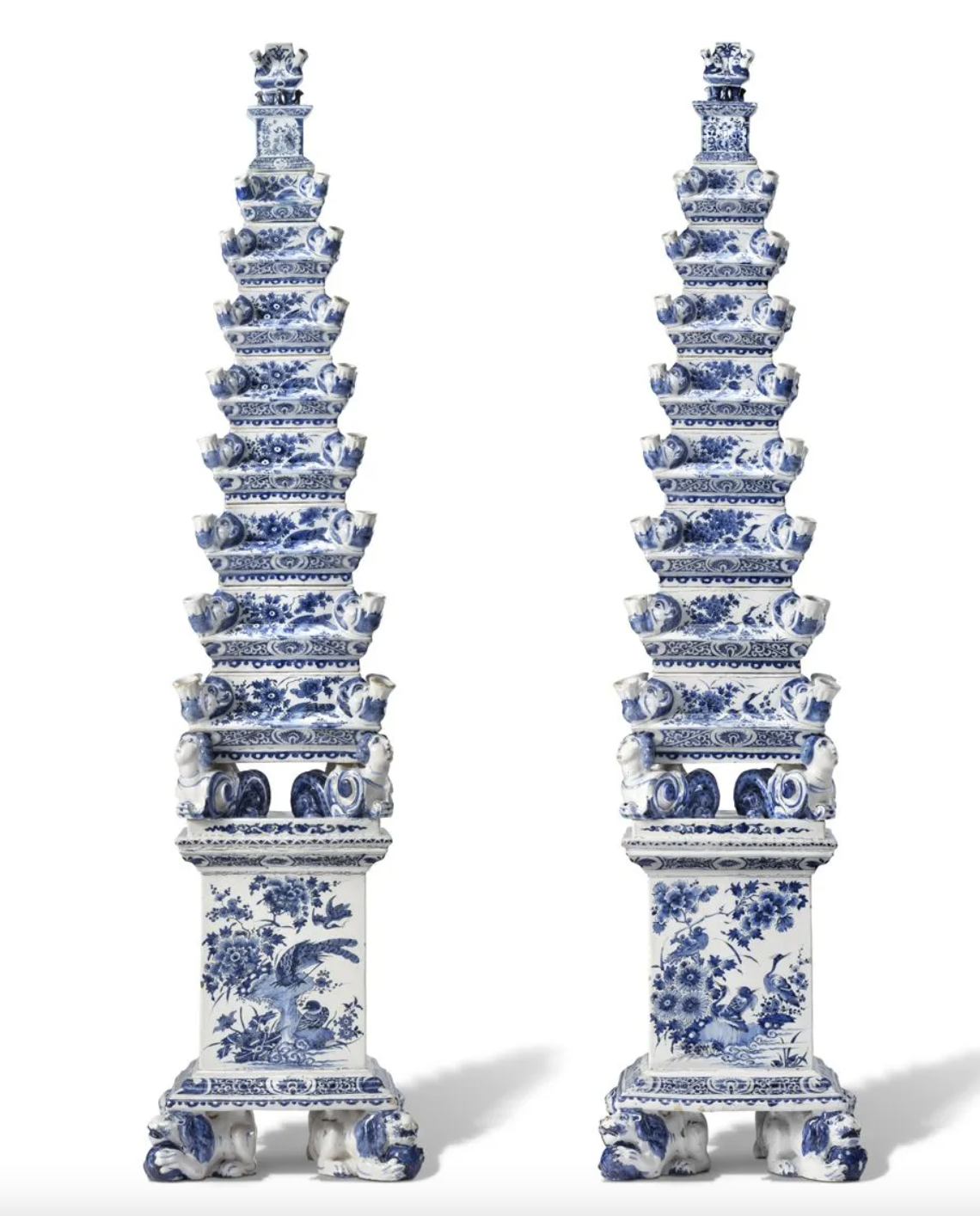
Delftware


Many of the British ceramics in Chipstone’s depict images of kings, queens, and other influential figures. One lovely exception is this 1720 delftware mug that depicts the Thames waterman John Giles. Records of the Company of Watermen and Lightermen indicate that Giles fulfilled his apprenticeship in 1697 and by 1707 was living in Queenhithe ward, where he sits in his “wherry” or canal boat in this pastoral scene.
Giles is portrayed leaning forward with his visible oar poised above the water. The shadows over the dappled water suggest it is a sunny summer day, as does the dense foliage of the trees, represented by the potter’s skillfully rendered green and blue sponge painting. The oarsman sits near the bank as another waterman rows past in the background. Perhaps to enhance the theme of water, the potter of this mug added a wavelike ornamental band around the bottom. While the trees in this scene look plausible for Giles’ locale, the oversized foliage and rocks are imaginative decorative motifs that the potter borrowed from imported Chinese ceramics.
Heightening the decorative merging of East and West on this mug is the careful depiction of Queenhithe in the background. Even in 1720, Queenhithe or “Queen’s Harbor” was an ancient site characterized by centuries of commercial activity. Established in 899, the dock soon became the main port for domestic trade between London and the countryside, and by the 16th century the surrounding area was a thriving working-class neighborhood. As an access point to the river, Queenhithe also became a center for watermen like Giles, who transported people rather than goods along the river. The “Waterman’s Stairs” can be seen in the background of this image, and they lead our eyes up to the ward’s church towers, which signaled home to Giles and his colleagues as they plied the river.
In certain respects, this carefully composed scene of activity on the Thames contrasts the harsh reality of life of watermen, who have been distinguished throughout British history for their toughness, expert knowledge of the river’s tides and currents, and colorful language. Like essential workers today, their job also brought great risks. The diarist Samuel Pepys described how in a 1665 plague outbreak, watermen were afraid to take passengers, and his waterman “buried a child and is dying himself.” Perhaps, then, John Giles especially enjoyed this happier representation of his life’s work, his river, boat, and home setting in Queenhithe.

Above images and text from Chipstone Foundation Facebook page.

The mission of The Chipstone Foundation is to promote and enhance appreciation and knowledge of American material culture (emphasizing the decorative arts) by scholars, students and the general public.


Below are excerpts from an article by Cath Pound, June 24, 2020 for the BBC. 


Chinese potters in Jingdezhen, a kiln city in the inland province of Jiangxi, first developed the technology to fire true porcelain in the 14th Century. Its production requires kiln temperatures of 1,300C, high enough to turn the glazing mixture to glassy transparency and fuse it with the clay body, after which designs are trapped between the two layers. The blue and white aesthetic the Dutch would later make their own was itself created to appeal to the Persian market who decorated their own ceramics with cobalt blue designs but could not match the whiteness of Chinese porcelain.  

Dutch traders were forbidden to travel inland to Jingdezhen so that the ceramicists could protect their secret. Instead they were required to order from intermediaries, and then Chinese ships would deliver them to Batavia (now Jakarta), the trading outpost the Dutch established in 1619, which would eventually become the capital of the Dutch East Indies. 

The popularity of Chinese porcelain meant that almost immediately ceramicists throughout Europe started to imitate it. The most successful of these imitators were, of course, those from Delft. But this was far from a uniquely Dutch triumph. “The tin-glazed technique used for it came from the Middle East to Islamic Spain through the island of Majorca, where the name majolica came from,” explains Lambooy. “In the 16th Century it then went to Faenza, where faience pottery comes from, and then to France.” A lot of Huguenots (French Protestants) then fled to Antwerp to escape persecution but following the fall of Antwerp to Spanish Catholic forces in 1585 these refugees were forced to flee further north. “Potters with Italian roots moved everywhere,” says Lambooy, “although it’s unknown why Delft exploded to become the centre”.

One theory is that beer breweries fell into disuse, allowing potters to take them over, and the fact that Delft was a major centre of the Dutch East India Company meant that there were plenty of Chinese originals for them to imitate. Whatever the case, after a period of experimentation the potters of Delft were producing pieces with all the characteristics of tin-glazed Delftware as we know it by 1620.

Although Delftware was created as a cheaper alternative to Chinese porcelain, which remained in great demand throughout the 17th Century, the ceramics produced were still the finest in Europe. Elites from across the continent, including the Sun King himself, Louis XIV, would order pieces.

Connect with colonialism:

Smaller Delftware items such as pots for exotic spices, including cloves, mace, cinnamon and pepper are an indication of the Dutch Republic’s colonial expansion, no doubt a source of pride for William and Mary. But the monopoly the Dutch East India Company had on the spice trade had a devastating impact on indigenous populations. A more explicit indication of the impact of colonialism can be found in a number of unusual Delft vases which are Chinese-influenced in every way – except for their depiction of black slaves. Although there is no evidence that enslaved people worked in the Delft potteries, whoever designed the vases was more than aware that slavery was part of Dutch culture, both at home and in the colonies. 


Terracotta Warriors

From the mausoleum of the first Qin Emperor of China

c. 221 - 206 B. C. E. 

Qin Dynasty

A vast underground city guarded by a life-size terracotta army including warriors, infantrymen, horses, chariots and all their attendant armor and weaponry. A sprawling citadel, complete with gardens and stables, bronze ritual vessels, jade jewelry, and a wealth of gold and silver ornaments.

Terracotta is an unglazed brownish-red clay that has been fired once. Closest example are the pots sold at hardware stores for planting house/outdoor plants. 


Painted terracotta, Terracotta Warriors and Horses Museum, Shaanxi, China
(photo: Keith Marshall, CC BY-NC-SA 2.0)


Painted terracotta, Terracotta Warriors and Horses Museum, Shaanxi, China
(photo: Will Clayton, CC BY 2.0)


The First Emperor is known for stunning innovations that consolidated his rule through modernization. During his reign, he introduced the standardization of currency, writing, measurements and more. He connected cities and states with advanced systems of roads and canals. He is also credited with continuing the construction of the Great Wall, which is perhaps the most widely-known symbol still associated with China to this day.


Armored infantryman wear body and shoulder armor. Their hands are positioned to hold a lance (left hand) and a crossbow (right hand). They wear their hair in a topknot covered by a soft cap that ties at the back. (photo: Romain Guy, CC: BY-NC-SA 2.0)


He is regarded as a military genius, and while his methods included massacre and destruction, some claim that his ultimate success at bringing the states together justifies the violence, a necessary cost of nation-building.

The cavalry horses are approximately life-size. They have a saddle 
but stirrups were not in use at this time (photo: The.Rohit, CC BY-NC 2.0)


The army includes over 7,000 terracotta warriors horses, chariots and weaponry intended to protect the emperor in the afterlife. The burial complex was first discovered by farmers in 1974.

(photo: NekaPearl, CC: BY-NC 2.0)


Above info
Source link:


Yiren  Shen, College Intern at The Metropolitan Museum in New York, posted a great research article on the making of the Terracotta Warriors ini 2017. 

To read full article go to link below. 


1. Preparing the Clay
The researchers mixed local yellow earth with grit. To ensure the evenness of the inner structure of clay, they stirred the mixture and immersed it in water while constantly beating it. Then they stored the prepared clay within containers to keep it moist for future use.

2. Building the Statue
The researchers made the statue by coiling clay strips, which explains why it is hollow. No armature was found inside the torso; the statue kept its balance with its own weight. The researchers speculated that some external support, such as linen or clay, might have been used to make sure that the body would not fall over during the building process.

After they had made the feet, they only added about 10 cm per day. The researchers paid special attention to the inner shape of the statue, since the center of gravity would shift as they added more bulk. Therefore, they used wooden sticks to beat the inside of the figure throughout the process. This made the clay body denser, removed air bubbles, and roughened the surface, so that when cracks appeared, they would not reach the innermost part.

The researchers argue that there were two possible methods for constructing the arms. They believe that the arms could have been made from the bottom up and built simultaneously with the torso, then closed up when they arrived at shoulder level. Or, the arms might have been extended after the torso was complete. Accordingly, the builders used the coiling technique to attach smaller clay strips next to the torso, and closed up the arms and the torso when they reached the same level.

3. Carving the Details
The researchers used both an addition and a subtraction method for carving details. They also used bamboo strips to smooth the surface at this stage.

4. Drying Process
During the lengthy process of drying the figures in the shade, the researchers applied dampened fabric on the surface of the statue to keep the clay plastic.

5. Making the Head
Again, the researchers used the coiling technique, but they applied a second layer of clay on top of the base, so that they could carve the facial details.

6. Firing Process
The researchers constructed the kiln inside the mausoleum site itself. The kiln can fit four reconstructed warrior statues at the same time. The weight of each statue was between 150 and 200 kg, and it took about six to 10 hours to fire the whole body evenly at over 1652° F. Sometimes the head was put on the body while firing and sometimes it was fired next to the body, depending on the weight of the head.

Read more and see images:

https://www.metmuseum.org/blogs/now-at-the-met/2017/terracotta-warriors-age-of-empires#:~:text=To%20what%20degree%20the%20statues,together%20before%20they%20were%20fired.

Friday, September 2, 2022

Dorchester Industrial School for Girls, Winchester, Massachusetts

The source did not identify the dolls as ceramic. However, I think, from examining the images, the forms are ceramic. If not, the forms can still offer inspiration for personal projects in our ceramic sculpture class. 


No two dolls were alike. For some girls, their doll may have been their only possession.
(Boston City Archaeology Program)


During the summer of 2015, City Archaeologist Joe Bagley and his team of volunteers from the City Archaeology Program conducted an archaeological dig at the site of the Dorchester Industrial School for Girls. They recovered 17,723 artifacts, the majority of which were deposited between 1859 and 1880. Their finds offer an intimate glimpse into the school’s operations and its occupants.


Prospective students went through an application process. In order to qualify for admission, the girls had to come from destitute families. For many, this meant their parent(s) were unable to support them financially, were prone to drinking and/or were incarcerated.  In other cases, the parent(s) were noted as ill, absent, or dead. By 1858, their popularity had grown such that for every one girl they accepted into the school, they had to turn away two. They felt it was important to “work thoroughly with a few than superficially for many.” 

When the school first opened, students accepted ranged in age from six years to fifteen years old, but by 1898 the directors raised the minimum age to eleven. Initially, the girls were educated, trained, and lived in the school, but by 1881 the girls began to attend Dorchester’s public schools and returned for their vocational training at the Centre Street property in the afternoons. The yard offered space for the girls to play and “not disturb the neighbors,” and accommodated their garden, which provided fresh food for their meals. Although the school did not affiliate with any religious organizations, the girls did attend the local Congregational Church.


The Dorchester Industrial School for Girls provided a unique system of individual guardianship. When the school placed girls into homes to work as domestic servants, they assigned each girl a guardian (usually a school manager), who checked in on the girl to make sure her placement was a satisfactory one. This relationship often lasted for years. This program was unusual, as most industrial schools ended their responsibility to their students once they left. The Dorchester school’s program was so unique that it was a topic of discussion at conferences and in professional publications.


More to see and read on source link:


Ceramic History


Stone cooking supports used to grill skewers of meat by Minoans in Santorini, Greece circa 1600 BCE. The line of holes in the base supplied coals with oxygen. Many consider modern "souvlaki" street kebabs a direct descendant of this portable food system. Museum of Prehistoric Thera, Greece.

Note: I lifted the image and text from Facebook group History Feels. No confirmation that forms are ceramic. However, if not ceramic, the forms still offer inspiration for our personal projects in our class. 

Here is the link I found to Museum of Prehistoric Thera in Greece:

http://odysseus.culture.gr/h/1/eh151.jsp?obj_id=3325

Thursday, August 25, 2022

Ceramics History

Clay tablet with cuneiform
2100 - 2000 BC
Copyright: Trustees of the British Museum
Source Link:

This tablet preserves an account of wages paid to workers 4,000 years ago. 

Developed in Ancient Mesopotamia, clay tablets were used for over 3,000 years. Scribes used a reed stylus to impress characters in moist clay. The tablets were usually dried in the sun or sometimes fired in kilns. 

Documents were often archived in libraries where they could survive for millennia.


Clay tablets from ancient Mesopotamia provide an entirely new insight to early medical history. 
(Photo: © The Trustees of the British Museum)
Go to link to read about this clay tablet:


cu·ne·i·form| kyo͞oˈnēəˌfôrm, ˈkyo͞onēəˌfôrm, ˈkyo͞onəˌfôrm | adjectivedenoting or relating to the wedge-shaped characters used in the ancient writing systems of Mesopotamia, Persia, and Ugarit, surviving mainly impressed on clay tablets: a cuneiform inscription.  Anatomy denoting three bones of the tarsus (ankle) between the navicular bone and the metatarsals.  mainly Biology wedge-shaped: the eggs are cuneiform.


https://peterborougharchaeology.org/archaeology-skills-techniques/pottery-identification/


Funerary ensemble from a young girl’s grave. 
Southern cemetery of Pydna (Alikes near Kitros), Pieria. 325–300 B.C.E.

This burial of a young girl contained 21 clay figurines, clay vessels, a gold coin of Philip II, and gold jewelry. Young children were often accompanied by large numbers of figurines that have been interpreted as farewell offerings or gifts that were made during the burial ceremony. Ensembles of clay figurines also often accompanied the burials of girls or young women, whose lives were cut short before they could attain marriageable age.
Source: